


FXOpen

Yesterday, the monthly oil market review was published:
→ OPEC expects global oil demand to increase by 2.25 million barrels per day (b/d) in 2024, representing a 2.2% increase compared to 2023.
→ In 2025, OPEC predicts a demand increase of 1.85 million barrels per day, reaching 106.21 million barrels per day. It is anticipated that the growth in oil consumption in 2025 will be driven by China, the Middle East, and India.
This aligns with Occidental Petroleum's perspective, where they anticipate a global oil shortage starting in 2025, as the pace of global oil demand growth is roughly four times higher than the volumes of new reserves.
However, according to Citi analysts, the price of Brent crude oil in 2025 is expected to be $60 per barrel due to oversupply.
As of today, the price of Brent crude oil is fluctuating in the consolidation zone around $77 per barrel. Market participants are closely monitoring the potential for an increase in the Brent oil price due to geopolitical tensions. For instance, Maersk has reported that escalation in the Red Sea and the Gulf of Aden will lead to disruptions in global logistics.
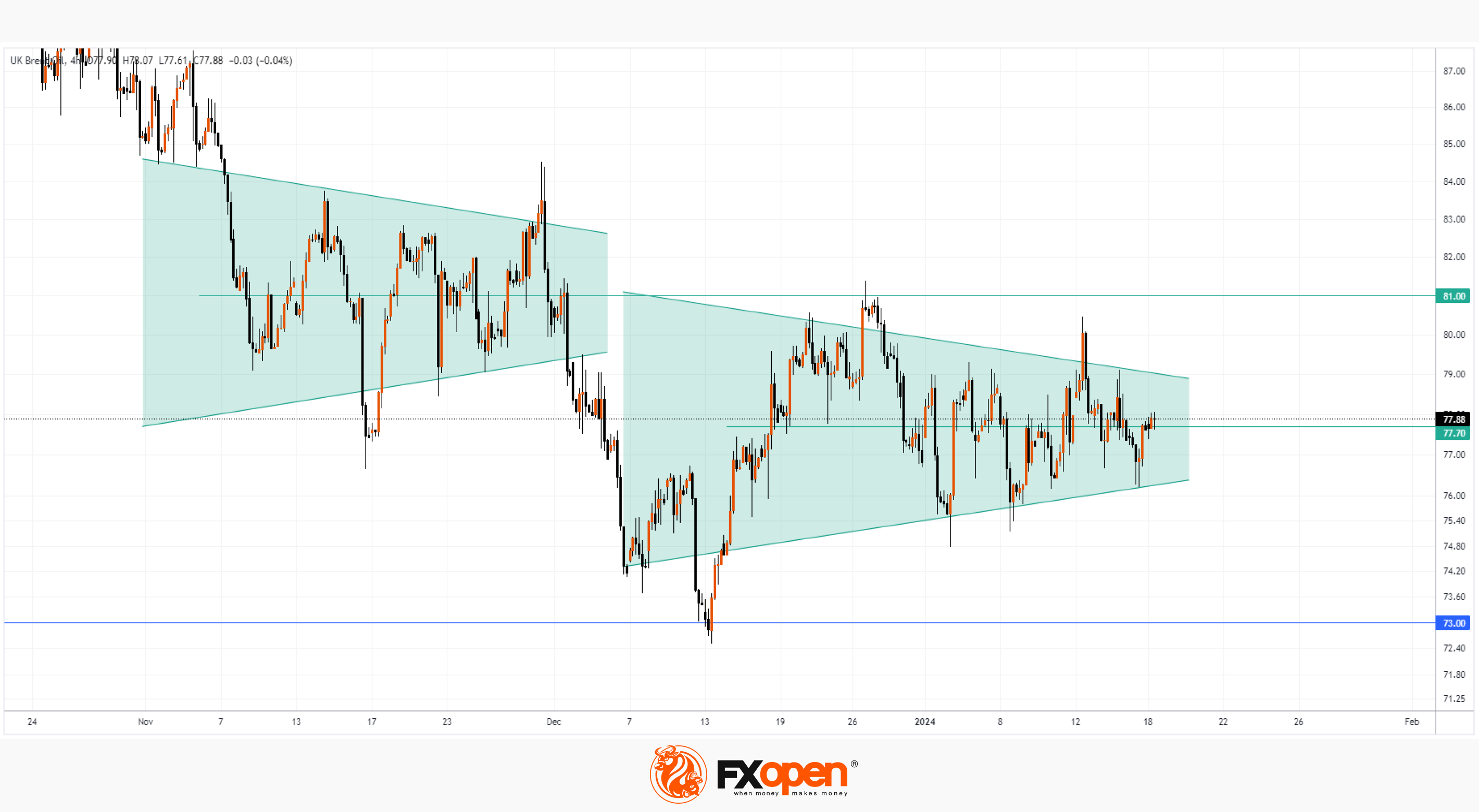
The Brent crude oil price chart indicates that
→ the new consolidation zone is lower than the previous one when the Brent price hovered around $81.
→ the price is near the crucial level of $73, which provided market support in 2023. At that time, OPEC+ countries announced a production cut to prevent further price decline. It is possible that they will take similar measures in 2024.
→ the rapid recovery of the price from December lows indicates the strength of demand for Brent oil below $74.
Given the provided information, if the Brent price falls below $74, it may lead to its subsequent increase.
Start trading commodity CFDs with tight spreads (additional fees may apply). Open your trading account now or learn more about trading commodity CFDs with FXOpen.
This article represents the opinion of the Companies operating under the FXOpen brand only. It is not to be construed as an offer, solicitation, or recommendation with respect to products and services provided by the Companies operating under the FXOpen brand, nor is it to be considered financial advice.
Stay ahead of the market!
Subscribe now to our mailing list and receive the latest market news and insights delivered directly to your inbox.


Latest articles

Consolidation Ahead of NFP: Commodity Currencies Search for Direction
Commodity-linked currencies have entered a consolidation phase following recent directional moves, as market participants adopt a wait-and-see approach ahead of key US labour market data. Current price action reflects a balance between ongoing demand for the US dollar and attempts

The Real Driver Behind the Dollar Rally: Market Insights with Gary Thomson
The US dollar has been firm, but the drivers behind the move may be more complex than they first appear.
While geopolitical tension and shifts in risk sentiment play a role, current price behaviour seems increasingly influenced by inflation expectations

EUR/USD and USD/CHF Pull Back: Market Reacts to Fundamentals
European currencies have shown a recovery in recent trading sessions after their recent decline, displaying early signs of a reversal. The US dollar is weakening amid expectations surrounding upcoming US macroeconomic data, while market participants are reassessing their short-term positions