


Oracle (ORCL) Shares Fall Below $150
FXOpen

The start of February has been negative for technology stocks, weighed down by a wave of pessimism driven by several factors, including:
→ “AI spending fatigue.” Results from Microsoft and Alphabet highlighted massive capital expenditure (CapEx). Tens of billions of dollars are being poured into servers and chips, and the market appears increasingly concerned that these costs may not be justified by actual AI-related revenues.
→ The launch of new “agent-based” AI tools (such as those released by Anthropic in early February), which has fuelled fears that AI could begin to replace software itself rather than enhance it. This has put pressure across the software sector, including Salesforce, Adobe and Oracle.
For Oracle, the situation is further complicated by plans to finance a large-scale programme in 2026 worth $45–50bn, which the company intends to fund by: 1) taking on debt; 2) issuing additional shares.
As a result:
→ analysts have downgraded their target prices for ORCL;
→ the share price has fallen below $150 for the first time since May 2025.
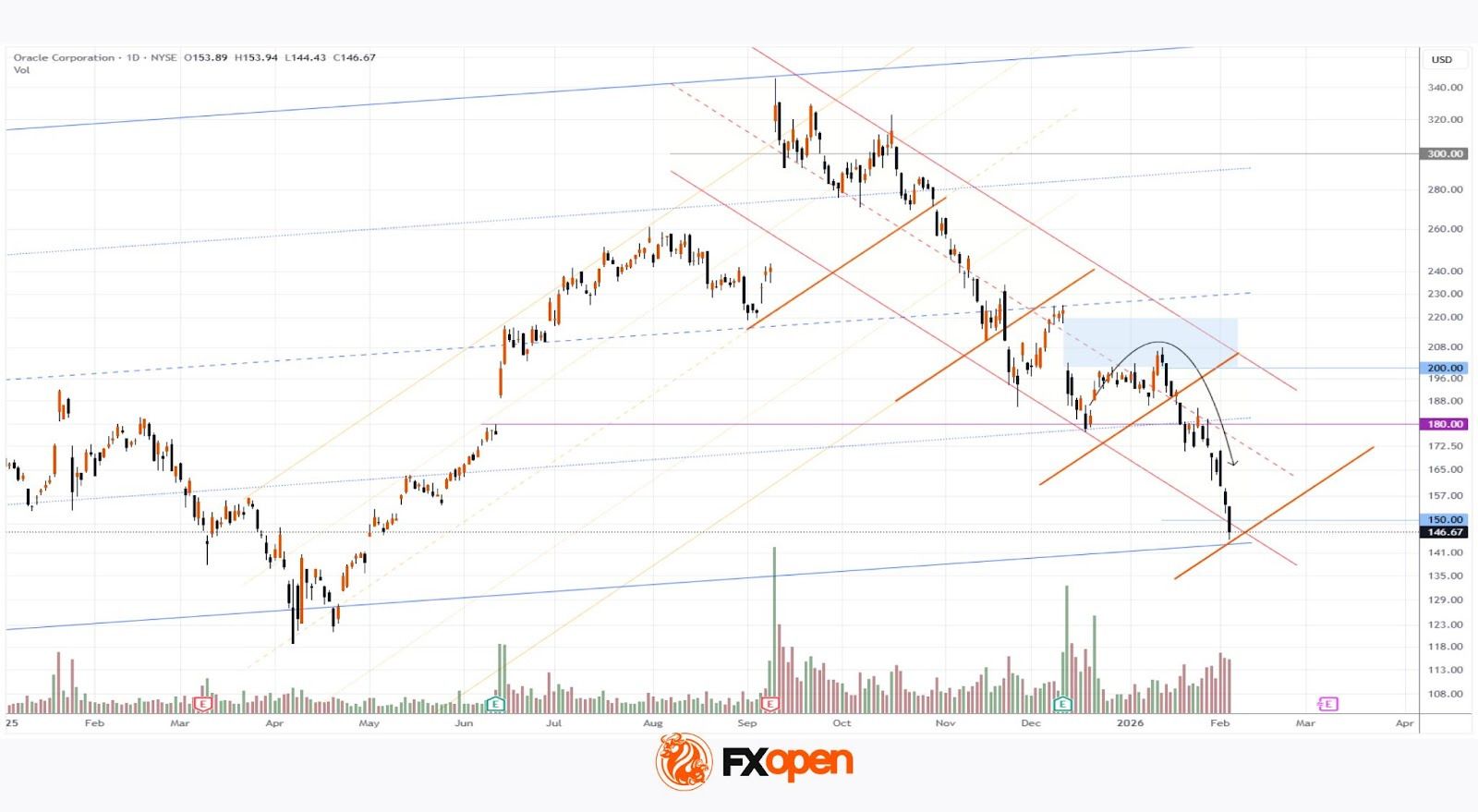
On 18 December, we noted that technical analysis of the ORCL share chart pointed to four reasons why a rebound towards the resistance area marked in blue was possible.
As the blue arrow shows, since then ORCL shares have:
→ shown signs of recovery;
→ however, a false bullish break above the psychological $200 level led to a resumption of the downtrend within the previously identified descending red channel.
The accelerating bearish momentum over the past three days may:
→ prompt weaker holders, gripped by panic, to sell ORCL shares;
→ attract “smart money”, which may view prices below $150 as appealing.
In addition, attention should be paid to the intersections of trend-channel lines from different timeframes. These may act as a cluster of support and slow the decline, giving the market a pause ahead of the quarterly earnings release scheduled for early March.
Buy and sell stocks of the world's biggest publicly-listed companies with CFDs on FXOpen’s trading platform. Open your FXOpen account now or learn more about trading share CFDs with FXOpen.
This article represents the opinion of the Companies operating under the FXOpen brand only. It is not to be construed as an offer, solicitation, or recommendation with respect to products and services provided by the Companies operating under the FXOpen brand, nor is it to be considered financial advice.
Stay ahead of the market!
Subscribe now to our mailing list and receive the latest market news and insights delivered directly to your inbox.


Latest articles

CAD/JPY: The Yen's Most Historic Move in 30 Years Meets a Fragile Support
Two central banks are heading in genuinely opposite directions this week, and the tension is unmistakable. The Bank of Canada held rates steady at 2.25% on September 2, with a mildly hawkish tilt as policymakers acknowledged a broadening economic

USD/JPY and USD/CAD Await Key Fed Decision
The US dollar is consolidating against the yen and Canadian dollar ahead of the key event of the week — the Federal Reserve meeting. The Fed is widely expected to raise its policy rate by 25 basis points to a range

UnitedHealth: Fundamentals Are Healing, Now the Chart Must Agree
UnitedHealth finds itself in a genuinely split narrative right now, trading near $388, down about 15.9% from its 52-week high, even as the fundamental picture keeps improving. Q2 earnings beat expectations, with revenue of $112.03 billion, and the