


The Magnificent Seven Stocks: A Stellar 2024 and an Uncertain 2025
FXOpen
The Magnificent Seven is a term used to describe the seven largest technology companies that dominate the global economy through their scale, innovation, and high market capitalisation.
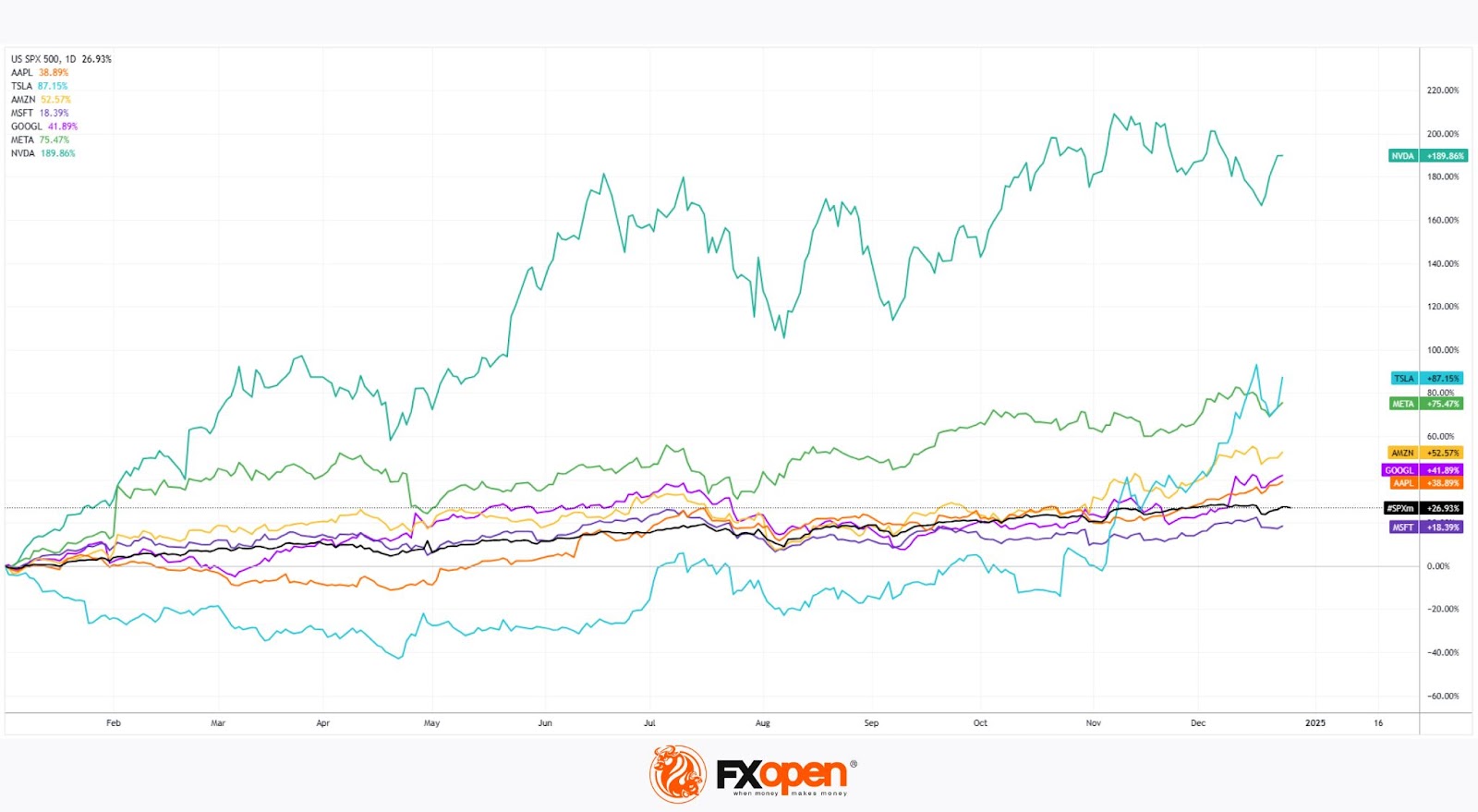
These companies are often key drivers of the US stock market, and in 2024 (as in 2023), they confirmed their leadership, with most outperforming the broader market indices. Below are approximate performance estimates for the end of 2024:
→ S&P 500 (US SPX 500 mini on FXOpen): +26%
→ Apple (AAPL): +38%
→ Microsoft (MSFT): +18%
→ Amazon (AMZN): +52%
→ Alphabet (GOOGL): +42%
→ Meta Platforms (META): +43%
→ Tesla (TSLA): +87%
→ Nvidia (NVDA): +189%
What does 2025 hold for the Magnificent Seven?
Motley Fool offers a cautious outlook for the coming year, suggesting that some of these leaders may run out of steam due to inflated stock prices relative to their intrinsic value and profit forecasts.
Zacks analysts have examined the fundamentals and identified three stocks from the Magnificent 7 that are worth considering for value investors:
1. Alphabet (GOOGL)
Alphabet has the lowest price-to-earnings (P/E) ratio among the Magnificent 7, standing at 23.9. While this doesn’t say it is a value stock (value stocks typically have a P/E below 15), it is relatively cheap compared to its peers. Moreover, Alphabet now pays dividends.
2. Meta Platforms (META)
Meta Platforms remains attractively valued with a forward P/E of just 25.8. It also boasts a relatively low price/earnings-to-growth (PEG) ratio of 1.3 (a PEG below 1.0 indicates a reasonable price relative to expected profit growth). The 1.3 PEG is appealing, and like Alphabet, Meta has started paying dividends.
3. Amazon.com (AMZN)
Once aiming to be the "store for everything," Amazon has expanded far beyond this with its AWS division, Whole Foods, sports and entertainment programming on Prime, and even chip manufacturing. Amazon has the lowest price-to-sales (P/S) ratio among the Magnificent Seven, at 3.8. Although a P/S below 1.0 is typically considered attractive, Amazon remains appealing to investors. For comparison, Microsoft’s P/S ratio is 13.1, while Nvidia’s is 29.
Buy and sell stocks of the world's biggest publicly-listed companies with CFDs on FXOpen’s trading platform. Open your FXOpen account now or learn more about trading share CFDs with FXOpen.
This article represents the opinion of the Companies operating under the FXOpen brand only. It is not to be construed as an offer, solicitation, or recommendation with respect to products and services provided by the Companies operating under the FXOpen brand, nor is it to be considered financial advice.
Stay ahead of the market!
Subscribe now to our mailing list and receive the latest market news and insights delivered directly to your inbox.


Latest articles
CAD/JPY: The Yen's Most Historic Move in 30 Years Meets a Fragile Support
Two central banks are heading in genuinely opposite directions this week, and the tension is unmistakable. The Bank of Canada held rates steady at 2.25% on September 2, with a mildly hawkish tilt as policymakers acknowledged a broadening economic

USD/JPY and USD/CAD Await Key Fed Decision
The US dollar is consolidating against the yen and Canadian dollar ahead of the key event of the week — the Federal Reserve meeting. The Fed is widely expected to raise its policy rate by 25 basis points to a range

UnitedHealth: Fundamentals Are Healing, Now the Chart Must Agree
UnitedHealth finds itself in a genuinely split narrative right now, trading near $388, down about 15.9% from its 52-week high, even as the fundamental picture keeps improving. Q2 earnings beat expectations, with revenue of $112.03 billion, and the