


FXOpen

The USD/JPY rate has consistently reached new highs since 1990, approaching the psychological level of 155 yen per US dollar. The Japanese currency has already fallen about 9% against the dollar this year.
This is supported by Jerome Powell, who suggested yesterday that US interest rates are likely to remain high for longer. He refused to give any guidance on when interest rates might be cut, greatly dimming investors' hopes for significant easing this year.
Market participants now expect a 40 basis point rate cut in 2024, significantly lower than the 160 basis point easing they were counting on at the start of the year, according to FedWatch.
At the same time, traders are focused on whether Japanese monetary authorities will intervene to support the currency as it deteriorates rapidly. Officials have stepped up warnings of possible intervention, although analysts also say fighting the dollar's strong bullish trend will be difficult and costly. Japanese Finance Minister Shunichi Suzuki said on Tuesday he was closely monitoring the yen's exchange rate against the US dollar today and would take "strengthened response measures if necessary."
“Today, intervention can only help slow or contain the pace of depreciation, but cannot reverse the trend,” Kenneth Broux, head of exchange rate research at Societe Generale, told Reuters. Japan last intervened in the foreign exchange market in 2022, spending an estimated USD 60 billion to defend the yen.
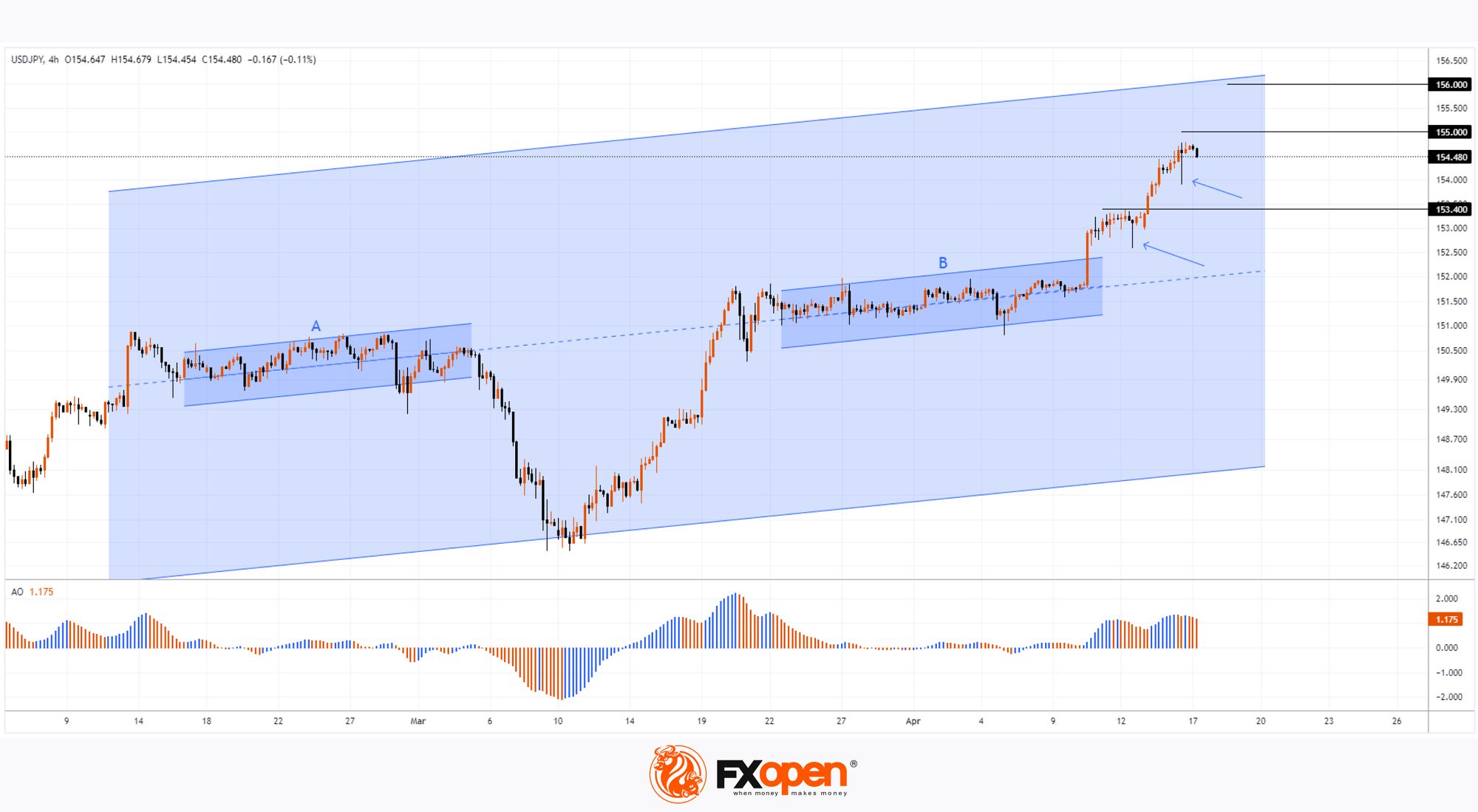
Technical analysis of the USD/JPY chart shows that the market is moving in an uptrend, judging by the fact that the Awesome indicator is above the zero line.
Wherein:
→ long lower shadows on the candles (shown by arrows) indicate the strength of demand;
→ if we take consolidation zones A and B as the basis for constructing the median of the ascending trend channel, and the March minimum as the basis for constructing its lower border, then the target of the unfolding growth may be the level of 156 yen per US dollar, where the upper border of the channel lies;
→ in case of a rollback, the USD/JPY price may be supported by the former resistance at 153.400.
Trade over 50 forex markets 24 hours a day with FXOpen. Take advantage of low commissions, deep liquidity, and spreads from 0.0 pips (additional fees may apply). Open your FXOpen account now or learn more about trading forex with FXOpen.
This article represents the opinion of the Companies operating under the FXOpen brand only. It is not to be construed as an offer, solicitation, or recommendation with respect to products and services provided by the Companies operating under the FXOpen brand, nor is it to be considered financial advice.
Stay ahead of the market!
Subscribe now to our mailing list and receive the latest market news and insights delivered directly to your inbox.


Latest articles

Consolidation Ahead of NFP: Commodity Currencies Search for Direction
Commodity-linked currencies have entered a consolidation phase following recent directional moves, as market participants adopt a wait-and-see approach ahead of key US labour market data. Current price action reflects a balance between ongoing demand for the US dollar and attempts

The Real Driver Behind the Dollar Rally: Market Insights with Gary Thomson
The US dollar has been firm, but the drivers behind the move may be more complex than they first appear.
While geopolitical tension and shifts in risk sentiment play a role, current price behaviour seems increasingly influenced by inflation expectations

EUR/USD and USD/CHF Pull Back: Market Reacts to Fundamentals
European currencies have shown a recovery in recent trading sessions after their recent decline, displaying early signs of a reversal. The US dollar is weakening amid expectations surrounding upcoming US macroeconomic data, while market participants are reassessing their short-term positions