


FXOpen

If there’s a commodity that changed the world we live in, that’s oil. Since its discovery, oil shaped up industries disrupted businesses and was the source of the progress we now take for granted.
Many associate oil with the driving industry only. In a way, it is normal.
Because automobiles are part of our everyday life, it is the first encounter with an oil product: gasoline. But oil or petroleum goes way beyond that.
Gasoline is only one product derived from oil. Kerosene is used in the aviation industry, for instance.
When refining oil, the residuals are used in the petrochemical industry, responsible for most of the plastics and polyester we use these days.
All of this influence makes oil a powerful product. Countries with big oil reserves end up having a big saying in international affairs.
Oil in the Financial World
There are many types of oil depending on where it comes from. Three of them are known the most: WTI (West Texas Intermediate), Brent and OPEC (Organization of Petroleum Exporting Countries) oil.
Like any commodity, the price of oil depends on supply and demand. Variations in inventory levels, for instance, determine the rise or fall in oil prices.
In the foreign exchange market, oil plays an important role. Brokers offer it as a CFD (Contract For Difference), and traders can smoothly go short or long oil like trading any other currency pair.
Oil is mostly traded in dollars. The petrodollar is one of the main contributors to the United States economic welfare in the last decades.
Coming back to trading, the price of oil influences the value of the currencies in producing countries. While most of oil producing countries don’t have a currency that plays a significant role in the FX market, there is one that does have: Canada.
CAD and Oil Colleration
One of the largest economies in the world, Canada has vast oil reserves. Moreover, it exports most of its oil to the United States.
Again, by oil, we refer not only to the raw product but the refined ones, as mentioned at the beginning of this article.
The Canadian oil industry is so vast that it influences the GDP (Gross Domestic Product), politics, and everything surrounding Canadian welfare. It employs many people both in the upstream and downstream businesses, and therefore the strength of the economy depends on the oil industry.
But the oil industry shifts with the price of oil. Hence, the Canadian economy shifts with the changes in the price of oil.
Because a currency reflects the strength of an economy, the CAD (Canadian Dollar) shifts with the price of oil too.
The rule goes that higher oil prices cause higher CAD. And the other way around: lower oil prices cause a drop in the Canadian Dollar.
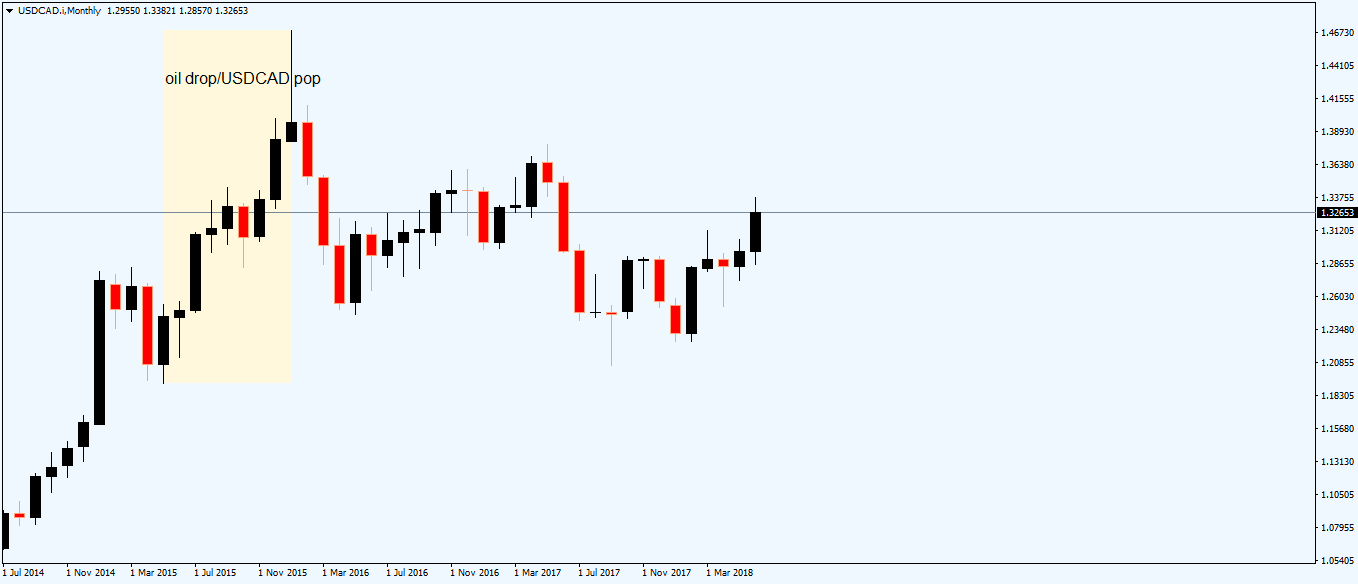
The major CAD FX pair is the USD/CAD. Hence, the direct correlation between the price of oil and the CAD has an inversed effect on the USD/CAD pair. Namely, higher oil leads to lower USD/CAD. And, lower oil to higher USD/CAD.
Conclusion
Oil is not the only factor driving CAD’s strength. But, for some time, it is the major one.
Hence, when trading USD/CAD or any other CAD pair, think of it as trading oil. Because, in fact, this is what you’ll do, despite not actually buying or selling oil.
This article represents the opinion of the Companies operating under the FXOpen brand only. It is not to be construed as an offer, solicitation, or recommendation with respect to products and services provided by the Companies operating under the FXOpen brand, nor is it to be considered financial advice.
Stay ahead of the market!
Subscribe now to our mailing list and receive the latest market news and insights delivered directly to your inbox.


Latest articles

Weekly Market Wrap With Gary Thomson: Nasdaq, EUR/USD, USD/CHF, Brent Crude Oil, Googl Shares
Get the latest scoop on the week's hottest headlines, all in one convenient video. Join Gary Thomson, the COO of FXOpen UK, as he breaks down the most significant news reports and shares his expert insights.
- Nasdaq Composite: Worst Session

Analysis of AUD/USD: Exchange Rate Falls to Early May Low
As indicated by the 4-hour AUD/USD chart today:
→ the rate fell below 0.652, a level last seen on May 2;
→ the RSI indicator dropped below 15, a level last seen during the panic over the spread of COVID-19

Analysis of AMZN Stock: Price at 1.5-Month Low
As shown in the AMZN chart, the stock price dropped below:
→ the psychological level of $180;
→ the mid-June interim low.
The last time AMZN traded below $180 was in early June.
Thus, AMZN has faced sell-offs, similar to other tech