


FXOpen
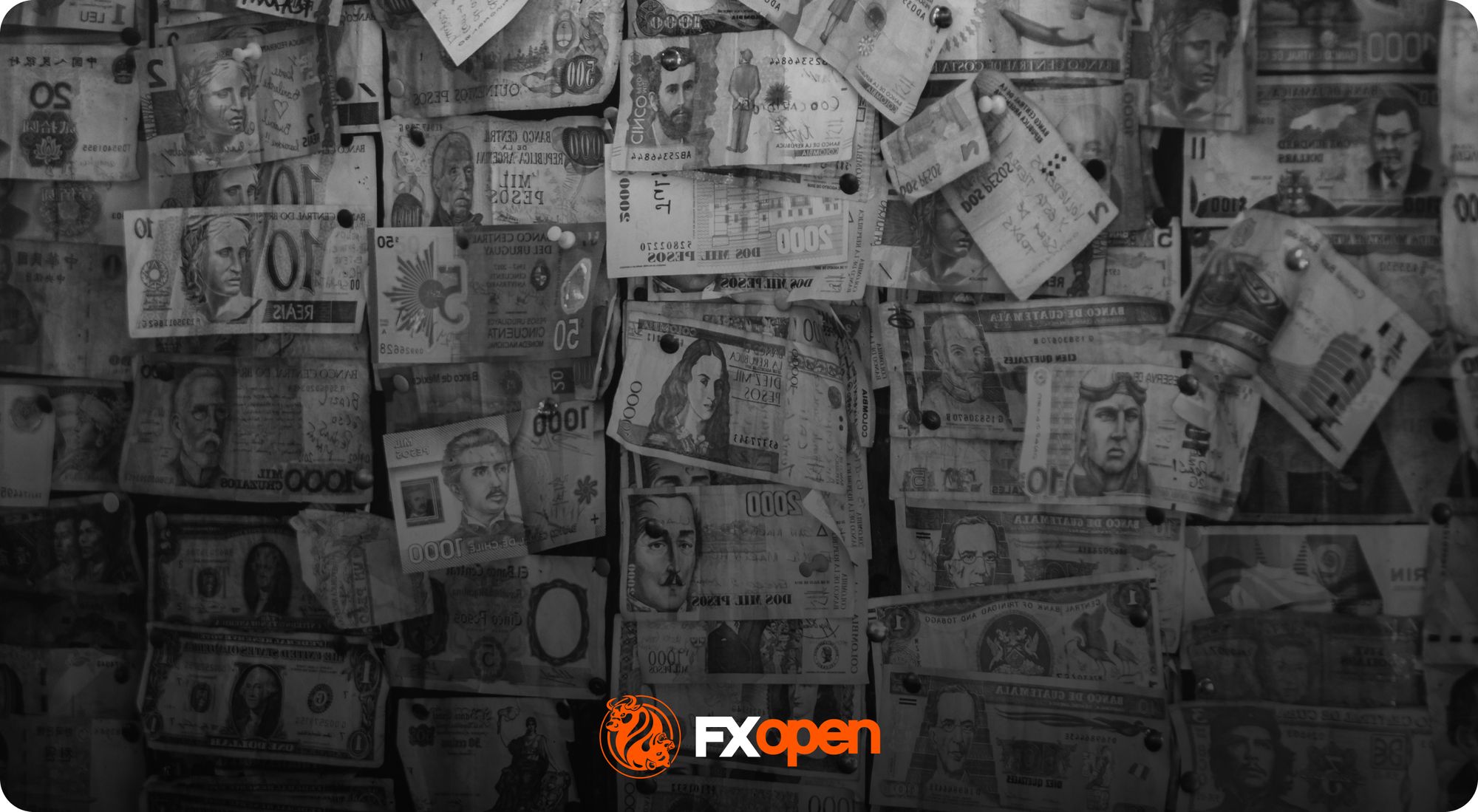
There are around 180 currencies in circulation around the world today. Some are strong, stronger than even the global benchmark, the US dollar. Others are exceptionally weak - so weak that even tens of thousands of units of the currency may not be enough to buy a single US dollar.
Economic crises, political and military instability, and persistent structural issues dent the value of these currencies and make them the cheapest currencies in the world. In this list, we’ll look at ten of the most worthless currencies in 2026, exploring what exactly has made them so weak.
Top 10 Weakest Currencies in the World 2026
So what is the weakest currency in the world? It’s the Iranian rial (IRR), a currency that’s rapidly risen up the ranks at the beginning of 2026 to become the world’s least valuable currency by quite a stretch. But while Iran’s issues are relatively unique, there are some commonalities between it and the rest on this list. As we’ll see, each currency has its own story, but the underlying pressures driving them are remarkably similar.
The ten least valuable currencies in the world are:
- Iranian rial (IRR)
- Lebanese pound (LBP)
- Vietnamese Dong (VND)
- Sierra Leonean Leone (SLE/SLL)
- Laotian Kip (LAK)
- Indonesian Rupiah (IDR)
- Uzbekistan Som (UZS)
- Guinean Franc (GNF)
- Paraguayan Guarani (PYG)
- Malagasy ariary (MGA)
*The rates are effective on the 16th of January, 2026.
1. Iranian Rial (IRR)
1 USD = 1,063,940 IRR
Iran ranks top in this list of countries with the least valuable currencies in the world
The rial has been used in Iran since 1932. People use banknotes like 20,000, 50,000 and 100,000 rials, and the central bank also issues cheques in 500,000 1 and 2 million rial denominations, which are not formally banknotes, but function like large-value cash equivalents.
In 2018, the Iranian currency was traded at the rate of around 42,000 to the US dollar (compared to 35,000 at the end of 2017) after President Donald Trump announced a unilateral withdrawal of the United States from the 2015 nuclear deal with Iran and the resumption of sanctions.
The Iranian rial has failed to recover ever since, with the country battling inflation above 40% (as of December 2025), continued economic sanctions, a dependence on oil exports, and internal political instability.
At the beginning of January 2026, the Iranian rial plunged to historic lows, sharply eroding people’s purchasing power and triggering widespread economic hardship and protests across the country as inflation and scarcity spiked.
The collapse of the currency intensified nationwide unrest over the cost of living and government performance, coinciding with renewed US pressure, including sanctions on Iranian officials and entities tied to the crackdown on protests — part of the broader strategy that has further constrained Iran’s oil revenue and access to foreign currency.
2. Lebanese Pound (LBP)
1 USD = 89,732 LBP
Second in this list of the top ten most worthless currencies is the Lebanese pound. The Lebanese pound has faced significant challenges and devaluation in recent years due to economic and political instability in Lebanon.
Before the economic crisis that began in late 2019, the Lebanese pound was pegged to the US dollar at a fixed exchange rate of approximately 1,500 LBP to 1 USD. However, 2019 brought a liquidity crunch that triggered mass protests and a two-week bank closure.
With the crisis exacerbated by the COVID-19 pandemic and the August 2020 Beirut port explosion, Lebanon eventually officially devalued the pound to 15,000 per USD in 2023. However, residents still had to contend with a mixture of rates, including an official peg, a central bank Sayrafa rate, and a parallel rate that reflected open-market value.
By early 2024, the central bank abandoned its Sayrafa platform rate of around 85,500 LBP per USD and aligned it close to the parallel market rate of around 89,500 LBP per USD.
3. Vietnamese Dong (VND)
1 USD = 26,275 VND
The Vietnamese dong is not the world’s most worthless currency, but it is close to achieving this title. While Vietnam has seen some of the fastest growth across Asia over the past 20 years, a series of devaluations since the 1980s have created a tremendously weak currency.
After the reunification of Vietnam in 1976, the government faced many challenges. In two years, a new monetary reform was carried out, and the Northern dong and the dong of South Vietnam were merged. Due to the increase in inflation in 1987-1991, new banknotes of 20,000 and 50,000 dongs were printed, and in 1994, a 100,000 VND banknote appeared.
The currency remained pegged to the dollar at around 11,000 VND per USD in the mid-1990s. However, a declining trade balance in 1996-1997 led the central bank to devalue the dong to around 14,000 by 1999.
Since then, the dong has been on a managed decline, approaching the low-20,000s by the early 2010s. The general weakening trend of the Vietnamese dong over the decades has helped the country maintain a growth in its export base.
4. Sierra Leonean Leone (SLE)
1 USD = 22.85 SLE (22,855 SLL)
The leone, the official currency of Sierra Leone, is one of the least valuable currencies in the world. Located in Africa, it’s one of the poorest countries on earth. Civil unrest, the recent war (1991-2002), and repeated battles with viruses such as Ebola do not allow the country to focus on economic prosperity. Coupled with the COVID-19 pandemic, these circumstances have further worsened the country’s situation, and its currency has depreciated even more than before.
Until the 1980s, the leone was stronger than the US dollar, but then it rapidly declined due to inflation. By the 2000s, thousands of leones were equivalent to a single US dollar. A new version of the leone called the SLE was announced in August 2021 and officially introduced in July 2022. It was worth 1,000 of the old leone (SLL). Although the current rate is 1 USD = 22.95 SLE, the leone can’t be excluded from the list of the weakest currencies.
Today, devaluation persists and continues to reduce the purchasing power of the leone, with inflation reaching the highest on record in 2023, at over 54% annually. There’s a hope that the rich reserves of natural resources will help Sierra Leone recover from the economic downturn in the coming years.
5. Laotian Kip (LAK)
1 USD = 21,669 LAK
The Lao kip (LAK) is one of the cheapest currencies in the world. The low currency value is not a new problem in this country. In 1979, the denomination was carried out: the kip of liberation from Pathet Lao, used since 1968, was replaced with new banknotes in the ratio of 100:1.
Since 1991, the country has suffered from bouts of severe inflation, including an average inflation rate of 128% in 1999. Since late 2021, the LAK has seen significant depreciation against the dollar. A double-shock, in the form of the COVID-19 pandemic and the war in Ukraine, hit the country’s tourism and export economy and increased the price of fuel and food, which Laos imports heavily.
The country’s debt-to-GDP ratio rose from 45% in 2015 to over 76% in 2023, and with the FX reserves necessary to repay the debt now depleted, the central bank’s ability to defend any particular exchange rate has diminished. The kip has since depreciated from just below 10,000 LAK per USD in late 2021 to an all-time low of over 22,000 LAK per USD in August 2024.
6. Indonesian Rupiah (IDR)
1 USD = 16,992 IDR
Indonesia is one of the few relatively wealthy countries in Southeast Asia. Its economy is stable, and the country is at a good stage of development; however, the currency exchange rates are still low.
High monthly inflation forced Indonesian regulatory authorities to carry out the denomination of the national currency. In 1965, a new rupiah was issued: the rate was 1,000 old rupiahs for one new. During the Asian financial crisis of 1997-1998, the exchange rate of the rupiah fell sharply by 35 percent.
In 2008-2011, the exchange rate fluctuated between 8,500 and 12,000 rupiahs per 1 US dollar. However, the 2010s saw the IDR almost halve in value, reaching over 15,000 rupiahs per dollar, driven by US interest rate hikes that drew money out of emerging markets like Indonesia and the country’s own persistent current account deficits.
While these issues continued to weaken the IDR into the 2020s, the currency has seen renewed weakness since the election of President Prabowo Subianto in March 2024, reaching an all-time low of 16,969 IDR per USD in April 2025. Concerns around Subianto’s domestic policies, like large fiscal giveaways, plans to weaken the central bank’s independence, and foreign investment restrictions, have helped trigger a decline in market confidence.
7. Uzbekistan Som (UZS)
1 USD = 12,026 UZS
Uzbekistan is a Central Asian country with one of the worst exchange rates against the US dollar. After the dissolution of the Soviet Union, the som became the legal means of payment in Uzbekistan.
Initially launched at 7 som per USD in 1994, the som quickly depreciated, dropping to 25 som per USD about six months later and hitting around 970 som per USD in December 2002. Managed decline helped to reduce inflation and stabilise depreciation into the mid-2010s, moving to around 3,000 som per USD in 2016.
However, in 2017, Uzbekistan abruptly liberalised its FX regime. The official rate plummeted from around 4,200 som per USD to over 8,000, slightly below the black-market rate of roughly 7,700 per USD. With the som now floating and moving in line with supply and demand, the currency has weakened as structural pressures, like a persistent trade deficit and stubbornly high inflation above 7% since 2017, show up in the price.
8. Guinean Franc (GNF)
1 USD = 8,772 GNF
Guinea is an African country with large reserves of valuable minerals; however, its national currency is one of the least valuable. The country is one of the world’s poorest, with high poverty rates and terrible crime rates.
Guinea has witnessed relentless inflation over the decades, with annual average inflation typically topping 10% since at least 2005. While not quite hyperinflation, the effects have devastated the Guinean franc.
The franc was first introduced in 1959 after Guinea’s independence from France, then reintroduced in 1985 after the interim national currency, the syli, eroded in value. Allowed to float, the franc also quickly depreciated into the early 2000s as periods of inflation and political instability hit.
While several monetary reforms in the 2000s attempted to address the franc’s weakness, they failed to address core issues, particularly inflation and a dependence on mining exports that created vulnerability to commodity price movements.
Reforms in the 2010s saw moderate success, but various crises, like the Ebola outbreak in 2014-2015 and COVID-19, coupled with a lack of FX reserves to manage the currency, have led to continued weakness. While a move from a low of 10,102 GNF per USD in early 2021 to 8,699 GNF today reflects a moderate improvement in national conditions, the franc remains exceptionally low value.
9. Paraguayan Guarani (PYG)
1 USD = 6,767 PYG
Paraguay ranks third in the list of the poorest South American countries. The local currency is named after the people inhabiting Paraguay – the Guarani tribe.
With the high inflation and the low value of the currency, céntimos (100 céntimos = 1 guarani) are no longer used in Paraguay, and coins of 1, 5 and 10 guarani are rare.
Initially pegged at 126 PYG per USD between 1960 and 1984, the guarani began to slide in the 1980s and 1990s as the artificial stability gave way to rising fiscal deficits and public debt. Between 2000 and 2002, the guarani fell dramatically as the effects of regional crises, like Brazil’s currency crisis in 1999 and Argentina’s economic collapse and debt default, spilled over. From the start of 2000 to the end of 2002, PYG fell from approximately 3,300 PYG per USD to a low of 7,400 PYG.
The currency actually strengthened significantly against the dollar from 2002 to 2014, a period marked by strong export cycles, relatively low inflation, and better economic discipline, reaching as high as 3,715 PYG per USD.
However, the overall downward trend has persisted from 2014 to today. A dip in commodity prices, a strong dollar, and worsening public finances, along with internal political instability, drove the guarani to its worst value ever in April 2025, at over 8,000 PYG per USD.
10. Malagasy Ariary (MGA)
1 USD = 4,652 MGA
Madagascar is an island nation off the coast of Africa, near Mozambique and South Africa. It’s a former French colony, which meant Madagascar used the Malagasy franc pre- and post-independence in 1960. Initially, a dependence on agricultural exports and a rising fiscal deficit drove depreciation of the franc, but the 1970s and 1980s triggered sharp franc devaluation.
The 1970s saw the implementation of radical socialist policies, where currency credibility declined and inflation rose. In the 1980s, IMF and World Bank programmes forced Madagascar to heavily devalue the franc and partially liberalise exchange rates. Persistent instability in the 1990s, culminating in a contested presidential election in the early 2000s, contributed to the relentless depreciation of the franc.
Madagascar replaced the franc in 2005 with the ariary at a rate of 1 ariary to 5 francs. However, the move only created a new denomination, rather than strengthening the underlying currency.
Since then, the ariary has only weakened, declining from 1,830 MGA per USD in 2005 to below 4,716 in 2025. While tighter FX management from the central bank and export earnings from higher commodity prices in the 2020s have helped to ease pressure, Madagascar’s issues remain multifaceted. Vanilla and nickel remain its key exports, and high inflation and weak public finances dampen any real chance at currency appreciation in the MGA.
Takeaway
Answering “what is the least valuable currency in the world?” reveals that commonalities exist between these weak currencies. Weakness has built over decades, driven by systemic issues that span multiple governments and remain tough to effectively deal with. Some countries have achieved moderate domestic stability, yet the cumulative effects of inflation, high external debt, and fragile export bases continue to show up in their currencies.
Interested in exploring the world of currencies and exchange rate movements? You can head over to the FXOpen’s TickTrader platform to view dozens of exchange rate pairs. Also, you can consider opening an FXOpen account to trade over 50 currencies with over 1,200 trading tools.
FAQ
What Country Has the Weakest Currency?
Iran currently has the weakest currency in the world. Iran currently has the weakest currency in the world. In early 2026, the Iranian rial fell sharply, eroding household purchasing power and intensifying financial distress as inflation and shortages worsened. The currency’s collapse heightened public frustration over rising living costs and government performance, while renewed US sanctions further restricted oil revenues and access to foreign currency.
What Is the Cheapest Currency in the World?
The Iranian rial is currently the cheapest currency by nominal value, worth around 1,063,940 IRR per 1 USD.
What Makes a Currency the "Lowest"?
A currency becomes the “lowest” when weak purchasing power and exchange rate levels mean the currency buys very little domestically or internationally.
What Country Has the Strongest Currency?
Kuwait has the strongest currency, the Kuwaiti dinar. As one of the world’s leading oil exporters, Kuwait has a large current account surplus that helps it defend its currency peg. The country itself is also stable and fiscally disciplined.
What Is the Oldest Currency Still Used?
The British pound is the oldest currency, still used in the United Kingdom. Its use dates back to around 775 AD, and it became England’s official currency in 928 AD.
This article represents the opinion of the Companies operating under the FXOpen brand only. It is not to be construed as an offer, solicitation, or recommendation with respect to products and services provided by the Companies operating under the FXOpen brand, nor is it to be considered financial advice.
Stay ahead of the market!
Subscribe now to our mailing list and receive the latest market news and insights delivered directly to your inbox.


Latest articles
Consolidation Ahead of NFP: Commodity Currencies Search for Direction
Commodity-linked currencies have entered a consolidation phase following recent directional moves, as market participants adopt a wait-and-see approach ahead of key US labour market data. Current price action reflects a balance between ongoing demand for the US dollar and attempts

The Real Driver Behind the Dollar Rally: Market Insights with Gary Thomson
The US dollar has been firm, but the drivers behind the move may be more complex than they first appear.
While geopolitical tension and shifts in risk sentiment play a role, current price behaviour seems increasingly influenced by inflation expectations

EUR/USD and USD/CHF Pull Back: Market Reacts to Fundamentals
European currencies have shown a recovery in recent trading sessions after their recent decline, displaying early signs of a reversal. The US dollar is weakening amid expectations surrounding upcoming US macroeconomic data, while market participants are reassessing their short-term positions