


FXOpen
The US Dollar (USD) extended downside movement against the Canadian Dollar (CAD) on Monday, dragging the price of USDCAD to less than 1.4150 following the release of some important economic releases. The technical bias remains bullish because of a Higher High in the recent upside rally.
Technical Analysis
As of this writing, the pair is being traded around 1.4131. A support can be noted near 1.3980, the 38.2% fib level ahead of 1.3761, the 50% fib level and then 1.3700, the psychological level. A break and daily closing below the 1.3700 support area could incite renewed selling pressure towards the 1.3271 support region as demonstrated in our daily chart.
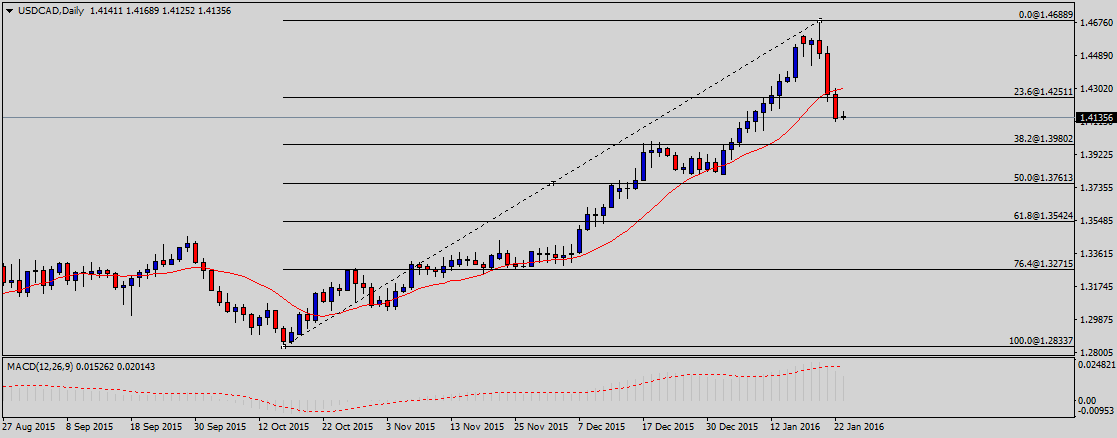
On the upside, the pair is expected to face a hurdle near 1.4251, the 23.6% fib level ahead of 1.4688, the swing high of the last major upside rally and then 1.5000, a major psychological level. The technical bias will remain bullish as long as the 1.3812 support area is intact.
Canada CPI
Annual inflation in Canada rose in December at its fastest pace in over a year as consumers paid higher prices for fruits and vegetables, in a sign of the impact a depreciating Canadian dollar is having on consumers’ pocketbooks. The all-items consumer-price index advanced 1.6% in December from a year earlier, Statistics Canada said Friday. The consensus among traders was for a 1.7% increase in December, according to economists at Royal Bank of Canada. On a month-over-month basis, headline CPI declined 0.5% in December, while core inflation dropped 0.4%.
Trade Idea
Considering the overall technical and fundamental outlook, selling the pair around current levels appears to be a good strategy in short to medium term.
Trade over 50 forex markets 24 hours a day with FXOpen. Take advantage of low commissions, deep liquidity, and spreads from 0.0 pips (additional fees may apply). Open your FXOpen account now or learn more about trading forex with FXOpen.
This article represents the opinion of the Companies operating under the FXOpen brand only. It is not to be construed as an offer, solicitation, or recommendation with respect to products and services provided by the Companies operating under the FXOpen brand, nor is it to be considered financial advice.
Stay ahead of the market!
Subscribe now to our mailing list and receive the latest market news and insights delivered directly to your inbox.


Latest articles

Market Insights with Gary Thomson: Where Are Oil, Gas & Global Indices Heading?
In this video, we’ll explore the key economic events and market trends, shaping the financial landscape. Get ready for insights into financial markets to help you navigate the week ahead. Let’s dive in!
In this episode of Market

Netflix (NFLX) Shares Pull Back After a 30% Surge
On 21 January, while analysing the NFLX chart, we:
→ identified a descending channel and a resistance zone around the $100 level;
→ noted that Netflix shares were showing a sustained downtrend. Selling pressure had been triggered primarily by reports of a
US Dollar Index (DXY) Rises Above the 100 Level
Today the US Dollar Index (DXY) climbed above the psychological 100 mark for the first time in 2026, supported by a tense fundamental backdrop, with the military conflict in the Middle East acting as the main driver.
→ Financial market participants