


FXOpen
There’s no better way to ride a market than looking for a strong trend and buying dips or selling spikes. However, the problem is that the currency market doesn’t trend that much.
And, on top of that, to find a trend is one thing. To define it and trade it using money management rules, is another.
As even the strongest trends have powerful pullbacks, the idea is to make the most of these pullbacks. A trending channel is easy to build, accurate in its signals, and provides an excellent money management setup for savvy traders.
Where a Channel Starts
With trending markets, the focus sits with the series of lower lows and lower highs in bearish trends, and higher highs and higher lows in bullish ones.
As long as the series remains in place, the trend continues, and it makes no sense fading it. Moreover, channeling conditions stay in place and give great trading opportunities.
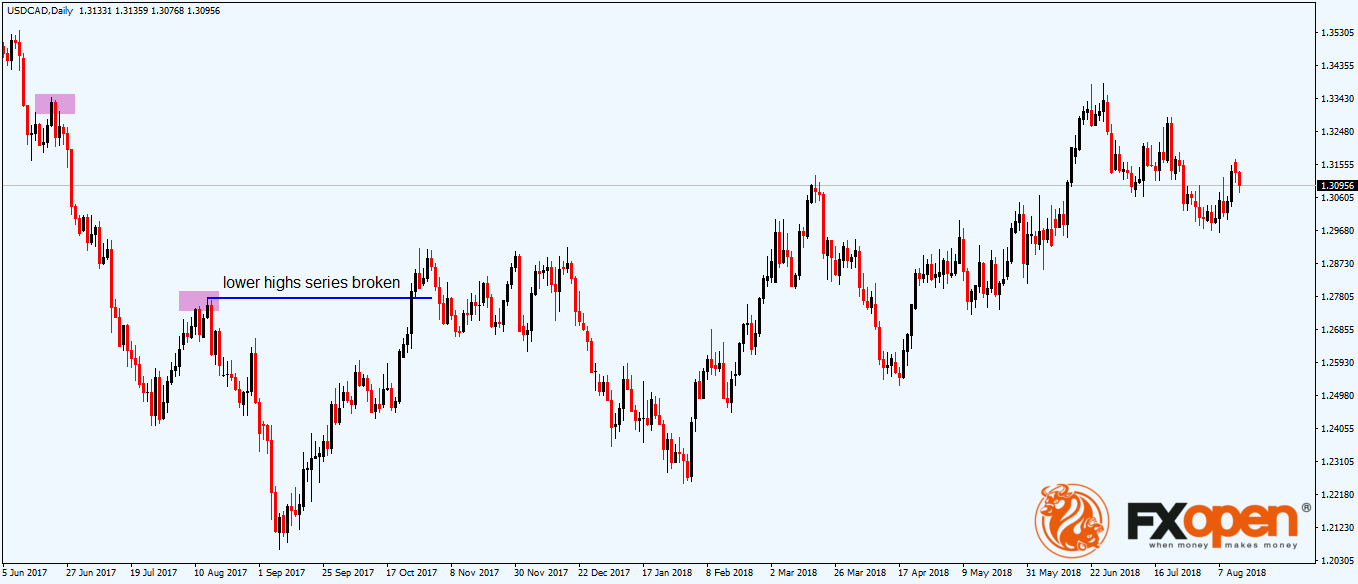
The USDCAD daily chart from above shows the current price action on one of the most popular currency pairs in retail Forex trading. The two rectangular shapes on the left side of it show the bearish market’s characteristics: lower lows and lower highs.
Until the series breaks, the bearish trend will continue. Bulls, or anyone interested in buying the pair, must wait for the price to break the series of lower highs. Only after that happens, we can say that the bulls won the fight and we can start looking for how to ride the new trend.
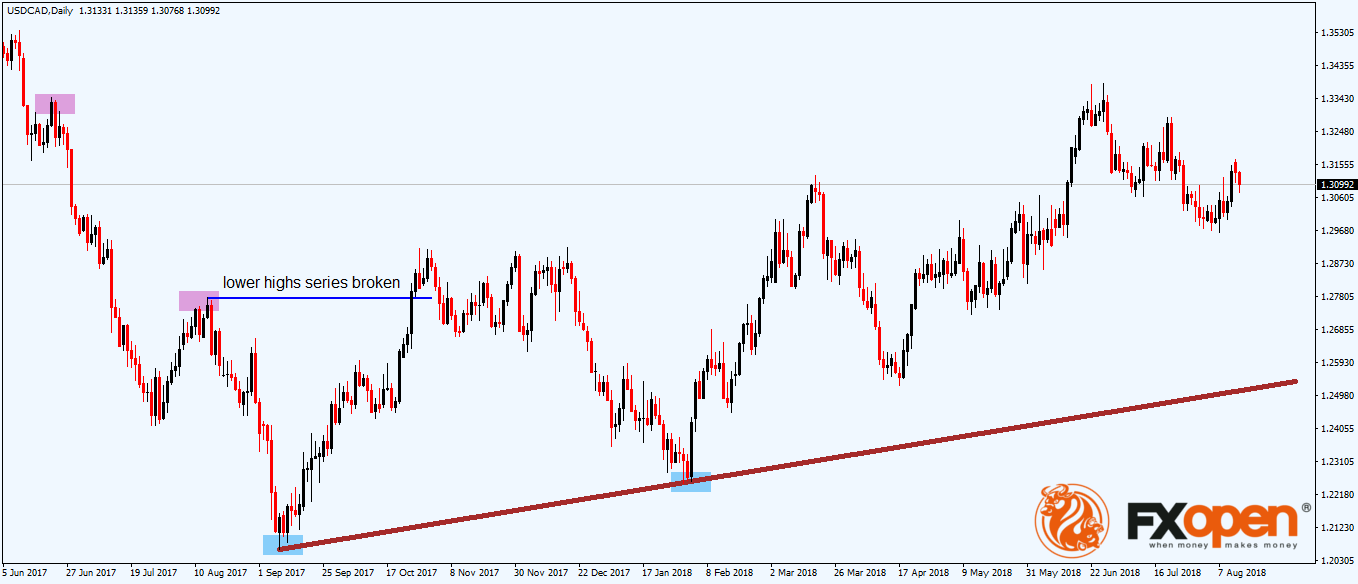
The starting point is the absolute low, as shown above. Providing the market doesn’t make a new low after breaking the previous lower highs series, traders draw a trendline connecting the absolute low with the first higher low. And, drag the trendline further on the right side of the chart.
Next, they use the first high of the new trend to project the trendline, thus building a rising channel.
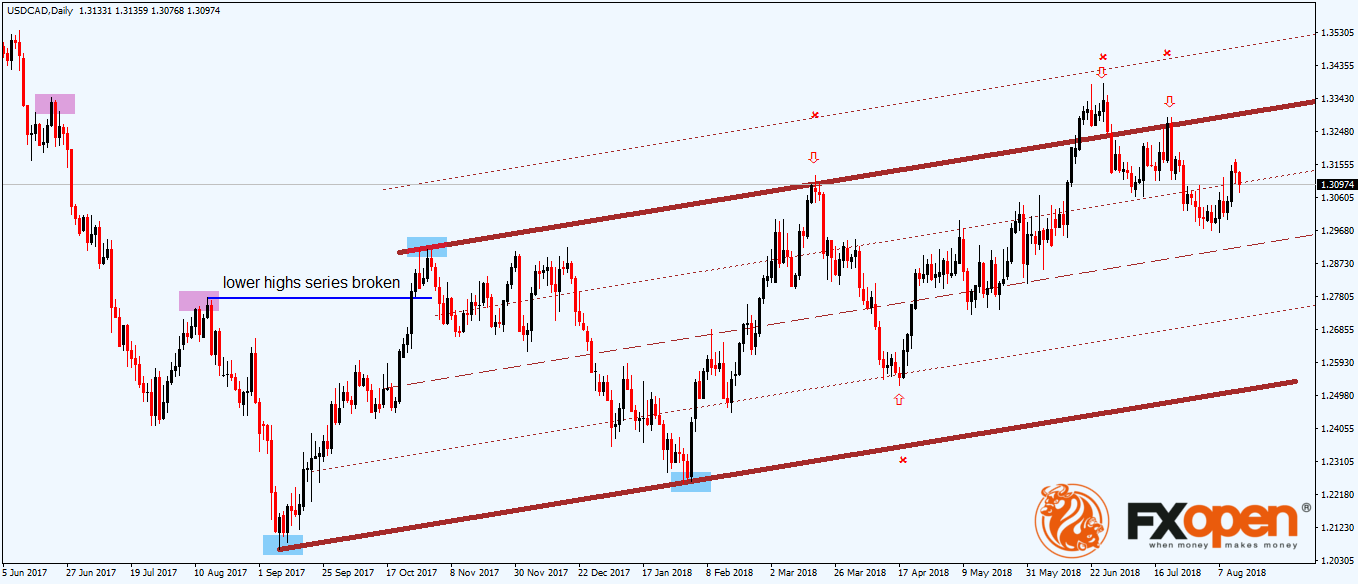
The beauty of a channel is that traders can buy and sell, despite the channel’s nature. Even a rising channel has an upper edge that provides dynamic resistance to price.
Here are the rules to trade a rising channel, and they can easily be used when trading a falling one:
- Split the channel into four equal parts;
- In a rising channel, buy the dip in the last quarter, with a stop loss on the main trendline, targeting the top of the channel;
- If stopped, buy the drop in the lower edge of the rising channel with a stop-loss at one-quarter projection and aiming still the upper side of the channel;
- Still in a rising channel, sell the spikes into the top edge of the channel, with a stop-loss at one-quarter projection and targeting 1:1 or 1:2 risk-reward ratios only.
The key stays with the channel’s nature. Countertrades don’t leave room for bigger risk-reward ratios, while the trades in the direction of the trend (channel) are more productive.
Conclusion
Rising and falling channels have the significant advantage of providing visible setups. It is reasonably easy to identify a trade part of a rising and falling channel while focusing on the series of lower lows and higher highs. When the series breaks, the channel’s trading setup is invalidated.
This article represents the opinion of the Companies operating under the FXOpen brand only. It is not to be construed as an offer, solicitation, or recommendation with respect to products and services provided by the Companies operating under the FXOpen brand, nor is it to be considered financial advice.
Stay ahead of the market!
Subscribe now to our mailing list and receive the latest market news and insights delivered directly to your inbox.


Latest articles

Consolidation Ahead of NFP: Commodity Currencies Search for Direction
Commodity-linked currencies have entered a consolidation phase following recent directional moves, as market participants adopt a wait-and-see approach ahead of key US labour market data. Current price action reflects a balance between ongoing demand for the US dollar and attempts

The Real Driver Behind the Dollar Rally: Market Insights with Gary Thomson
The US dollar has been firm, but the drivers behind the move may be more complex than they first appear.
While geopolitical tension and shifts in risk sentiment play a role, current price behaviour seems increasingly influenced by inflation expectations

EUR/USD and USD/CHF Pull Back: Market Reacts to Fundamentals
European currencies have shown a recovery in recent trading sessions after their recent decline, displaying early signs of a reversal. The US dollar is weakening amid expectations surrounding upcoming US macroeconomic data, while market participants are reassessing their short-term positions