FXOpen

The diamond chart pattern is a technical analysis formation that appears on price charts after a strong trend and often signals a trend reversal. The structure consists of a broadening phase (higher highs and lower lows) followed by a contracting phase (lower highs and higher lows), creating a shape that resembles a diamond. Traders analyse this pattern to identify trend exhaustion, breakout levels, and possible changes in market direction.
This article explains the structure of the diamond chart pattern, the market psychology behind it, and how to trade the diamond pattern.
What Is the Diamond Chart Pattern?
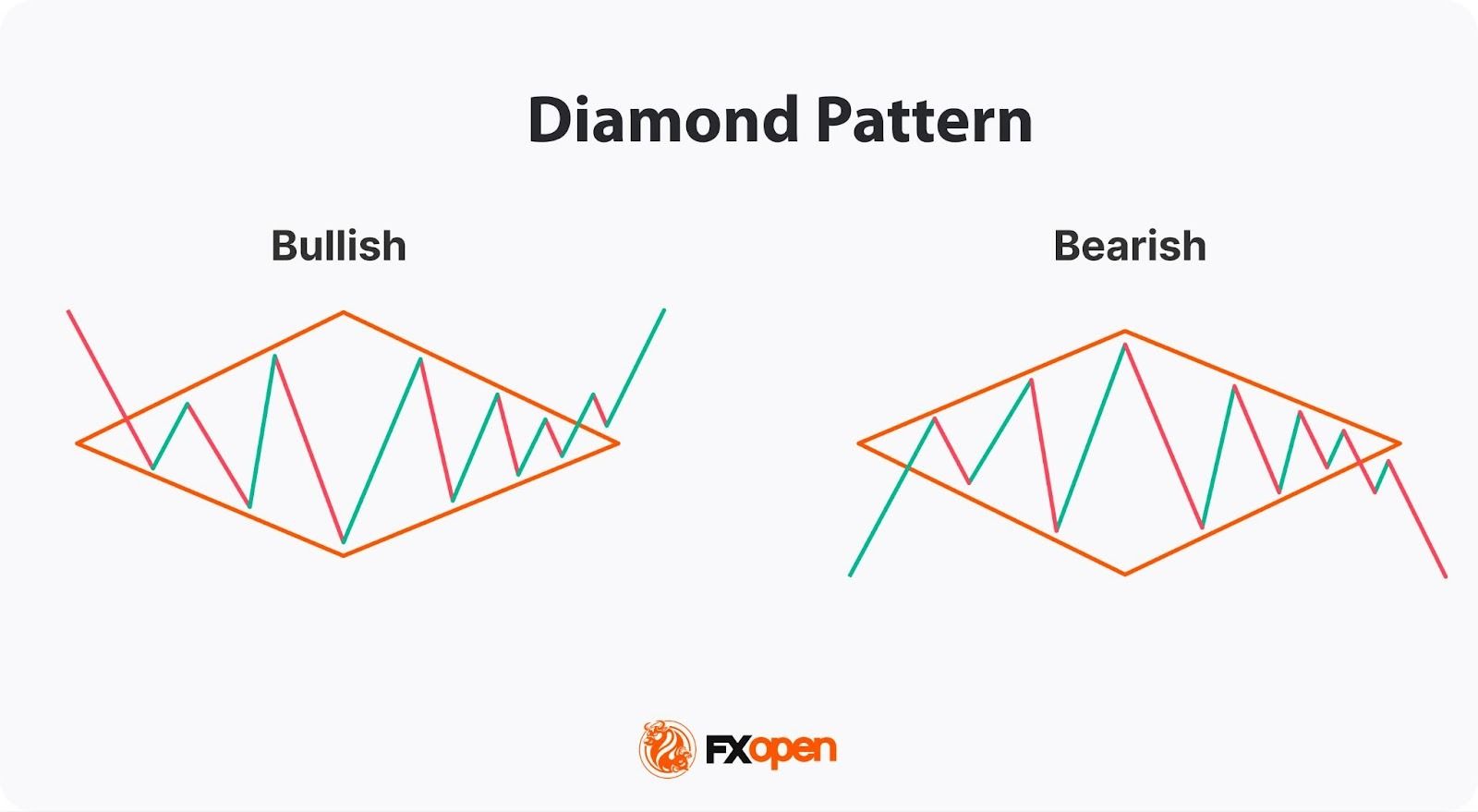
The diamond pattern is a technical analysis formation that develops after a strong trend and often signals a potential market reversal. It forms when price movements first create higher highs and lower lows, producing a broadening structure, and then shift to lower highs and higher lows, creating a contracting structure. Together these movements form a diamond-shaped pattern on the chart.
The diamond pattern can be either bearish or bullish, and it is also known as the diamond top pattern and diamond bottom pattern for trading. Both formations share the same structural characteristics but occur in different market conditions and signal different potential outcomes.
- A bearish diamond pattern occurs during an uptrend and signals a potential reversal to the downside.
- A bullish diamond pattern in trading forms during a downtrend and signals a potential reversal to the upside.
Market Psychology Behind the Diamond Pattern
The diamond pattern in trading reflects a gradual shift in market sentiment. During the expansion phase, price swings become wider as buyers and sellers compete for control of the market. This stage often reflects uncertainty and heightened volatility.
As the formation progresses, volatility begins to contract. Price movements become narrower, suggesting that the market is moving towards a new balance between supply and demand.
The eventual breakout from the pattern typically represents a decisive shift in control. If buyers dominate, the price may break upward. If sellers take control, the breakout may occur to the downside. For this reason, traders often analyse the diamond pattern as a signal of potential trend exhaustion and a possible change in market direction.
How to Identify a Diamond Pattern on a Chart
The diamond pattern has a distinctive but relatively straightforward structure. Traders follow certain steps to spot it on the chart.
- Look for a strong trend – A diamond usually forms after a strong upward or downward trend, when the market begins to lose momentum and volatility increases.
- Identify an expansion phase – Price forms a sequence of higher highs and lower lows, creating a broadening structure and reflecting increasing volatility.
- Identify a contraction phase – Price movements begin to narrow, producing lower highs and higher lows.
- Draw the trendlines – Traders outline the structure with four trendlines that form a diamond shape.
Diamond Pattern Statistics
The diamond chart pattern is less common than formations such as triangles or head and shoulders. However, it can precede significant price movements. Research by technical analyst Thomas Bulkowski shows that diamond bottom patterns break upward about 73–74% of the time, with an average rise of roughly 35–39% after the breakout. Diamond top patterns break downward about 54% of the time, with an average decline of around 17%.
How to Trade the Diamond Reversal Pattern
Like most chart patterns, this formation has particular rules traders can use to build their own trading strategies. These rules can be applied to the diamond pattern in forex, stock, commodity, and cryptocurrency* markets.
Entry
Traders typically buy after the price breaks above the upper boundary of the pattern and sell after the price falls below the lower boundary.
The breakout signals a potential trend reversal.
- If the breakout occurs above the upper trendline after a downtrend, it signals a bullish reversal.
- In the bearish diamond pattern, the breakout occurs below the lower trendline, which signals a bearish reversal.
Traders use several confirmation tools. The first one is rising trading volume. The breakout should be accompanied by an increase in trading volume. Low trading volumes usually signal a false breakout, whereby the price returns to its previous trend. Fakeouts can be caused by market volatility, news events, or other factors that disrupt its validity.
The second tool is multiple timeframe analysis. For example, if a diamond is forming on the hourly chart, traders may look at higher timeframes, such as the 4-hour or daily chart. If the breakout aligns with the trend on multiple timeframes, it may provide a stronger trading signal.
Target
The take-profit target typically equals the width of the diamond setup. Traders measure the vertical distance between the highest high and the lowest low and add that distance to the breakout point in the bullish formation or subtract this distance from the breakout point in the bearish formation.
Stop Loss
Traders typically place stop-loss orders just beyond the level opposite to the breakout. Another approach is to place stop loss beyond the apex, which is the highest point in a diamond top pattern or the lowest point in a diamond bottom pattern.
Special Consideration
Although the diamond is primarily considered a reversal formation, it can also indicate the continuation of an existing trend. Traders can see it appearing within the context of a strong trend and interpret it as a pause before it resumes.
In the case of a diamond continuation pattern, traders go short on the breakout of the lower trendline of the diamond and go long on the breakout of its upper trendline. Still, the profit target and stop-loss point will be calculated similarly to the reversal formation.
Tools and Resources Traders May Use to Confirm the Diamond
To confirm the diamond formation, traders often rely on a combination of technical indicators and fundamental analysis. These tools provide additional layers of validation and may help filter out false signals.
- Volume Analysis: An increase in volume accompanying the diamond pattern breakout suggests strong market interest. Conversely, low volume may indicate a false breakout.
- Momentum Indicators: Divergence—where the indicator moves opposite to the price—can signal a potential reversal and confirm the pattern’s signals.
- Moving Averages: When the price crosses above or below moving averages in conjunction with the diamond reversal pattern, it might offer stronger confirmation of the breakout direction.
- Fundamental News Events: Major economic announcements or geopolitical events can trigger significant price movements that align with a breakout from a diamond. Tracking these events may help us understand the broader context.
Diamond Pattern Trading Strategies
The diamond formation can be used in various trading strategies. Here are some common approaches that traders can utilise.
Diamond Pattern Breakout Trading
One of the most straightforward strategies with the diamond setup is to trade breakouts.
Entry: Traders enter the market in the breakout direction. They wait for the price to break above the upper trendline in a diamond bottom formation or below the lower trendline in a diamond top trading pattern.
Stop loss: Traders usually place a stop-loss order below the lower line in a bullish formation or above the upper line in a bearish formation. Another option is to consider the risk-reward ratio of 1:2 or 1:3.
Take profit: The most common approach is to measure the difference between the diamond's highest high and lowest low. This distance is added to the breakout point for a bullish breakout and subtracted from the breakout point for a bearish breakout. If traders trade in a solid trend, a take-profit target can be trailed.
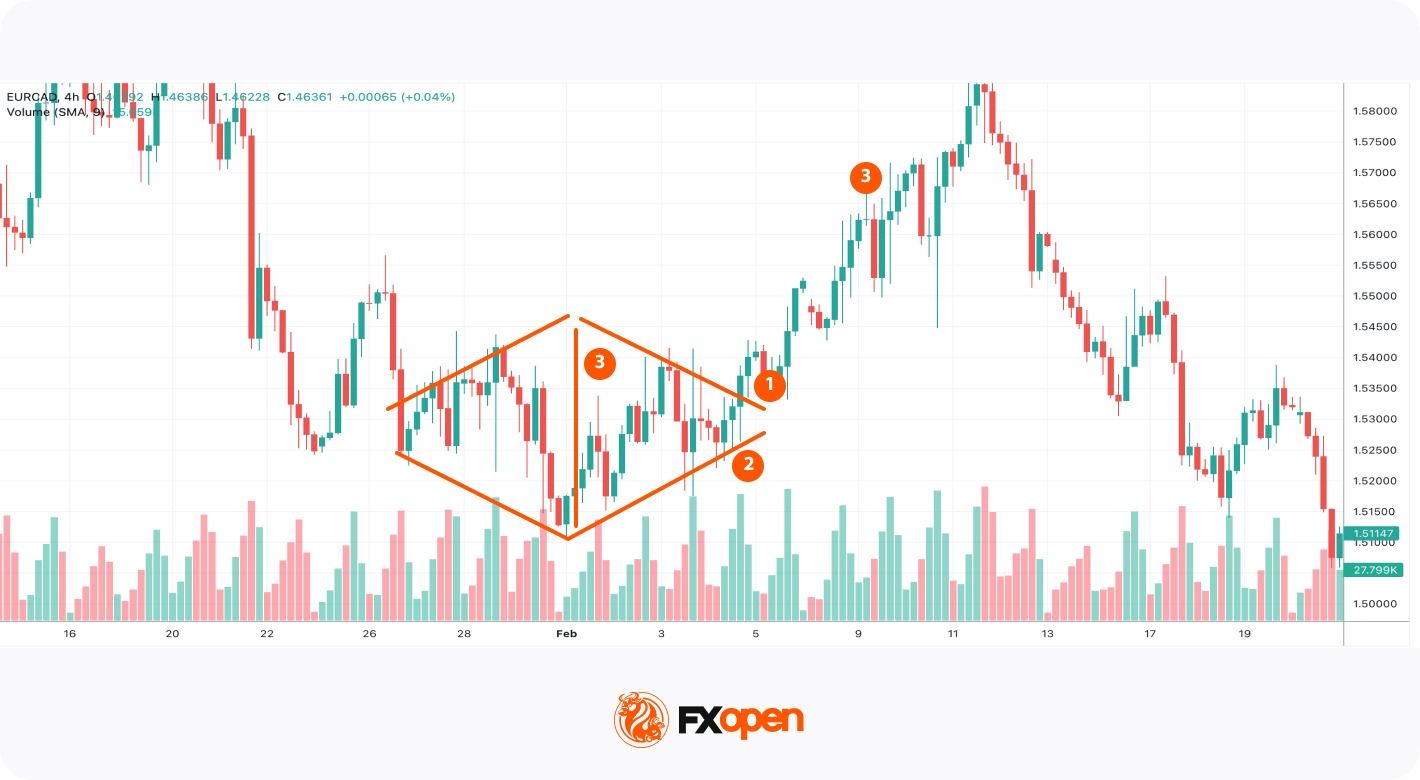
In the chart above, a bullish diamond formed after a prolonged downtrend. The price broke above the upper line (1). The volumes on the breakout increased significantly, so a trader could have expected bulls to push the price higher. A trader could have placed a stop-loss level below the lower line (2). After that, a trader could have measured the distance between the highest and the lowest points and added this to the breakout point (3). The bullish trend was strong, so a trader could have trailed that take-profit target.
Retracement and Reversal Trading
Another strategy is to look for price retracements.
Entry: Traders wait for the price to retest the broken trendline and then enter a trade in the breakout direction. In this approach, traders usually use a limit order.
Stop loss: Stop loss is placed below the retracement level in the bullish pattern and above the retracement level in case of a bearish setup.
Take profit: A profit target is calculated based on the distance between the highest and lowest points. The distance is added to the breakout point in the bullish formation or subtracted from the breakout point in a bearish formation.
Trailing stop-loss and take-profit orders can be applied to this approach.
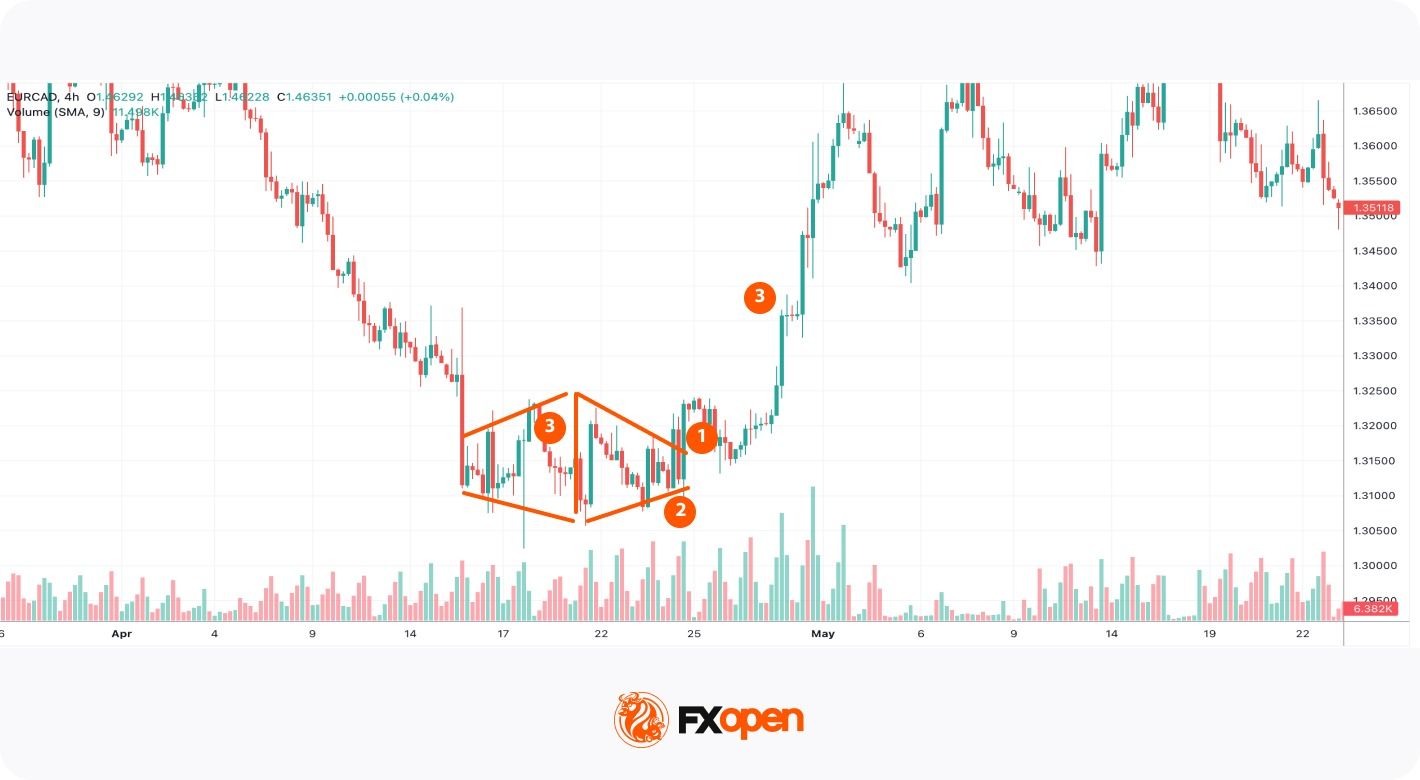
In the chart above, a diamond bottom pattern was formed. The price broke above the formation's upper line, but it retested it later (1). A trader could have placed a buy limit order at the upper line. A stop-loss could have been placed below the lower line (2), while a take-profit target could have equalled the distance between the highest and lowest points of the formation (3).
This strategy may support traders in catching potential trend reversals. However, there is a risk of a missing trade as the price may keep moving in a breakout direction without a retracement.
If you want to practice these trading approaches, you may consider opening an account on FXOpen’s TickTrader trading platform and access numerous technical analysis tools and assets.
Diamond vs Head and Shoulders
The diamond formation is commonly compared to the head and shoulders setup. However, they have different trading rules; therefore, it’s vital to learn how to distinguish between them.
The head and shoulders formation consists of three peaks, with the middle peak (the head) being higher than the other two peaks (the shoulders) and is formed at the end of an uptrend. The inverse head and shoulders pattern consists of three troughs, with the middle one being lower (head) than the other two troughs, and it appears at the end of a downtrend.
The diamond, on the other hand, is characterised by a series of higher highs and lower lows which turn into lower highs and higher lows.
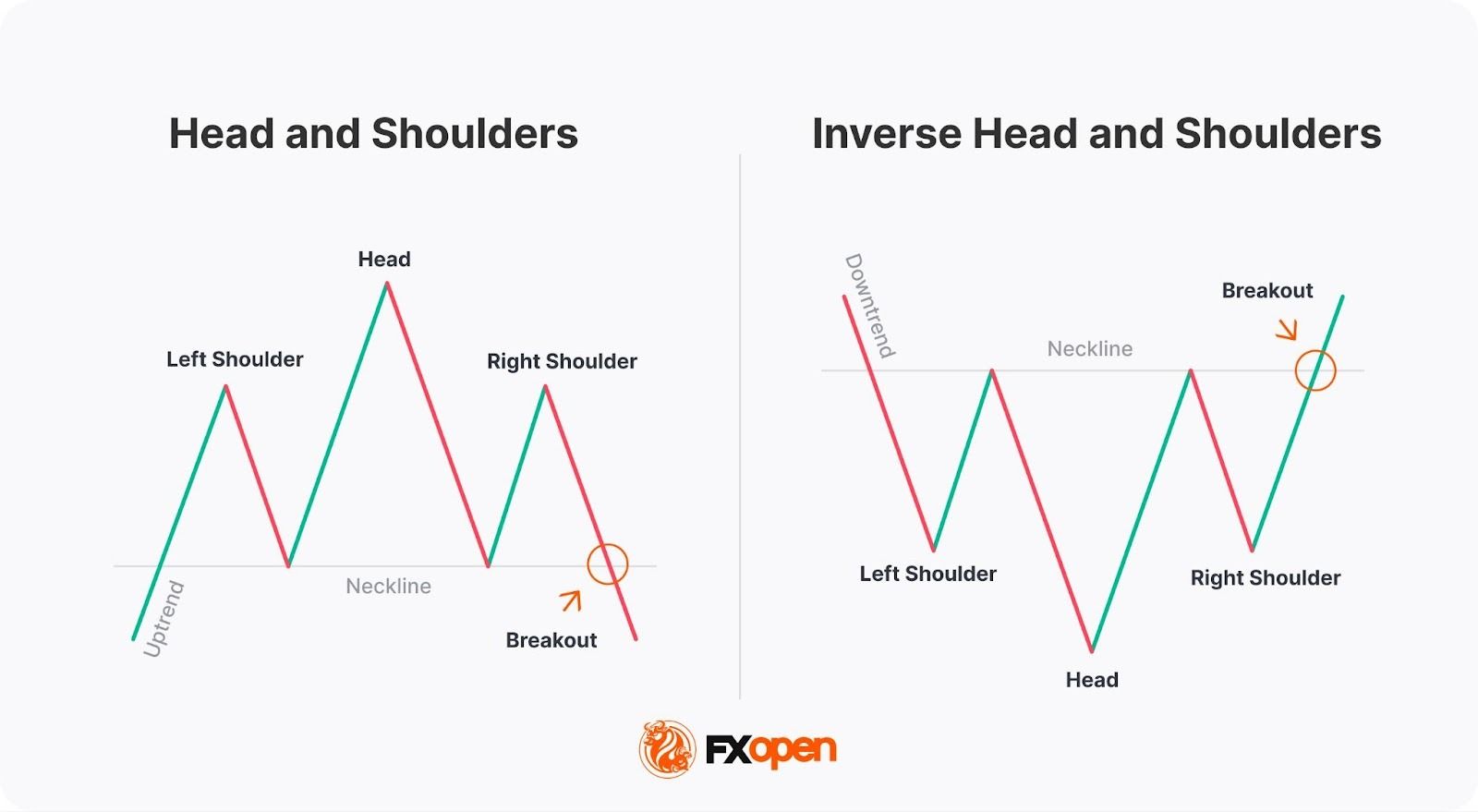
When trading the (inverse) head and shoulders setup, traders measure the distance between the head and the neckline (the line drawn through troughs in the head and shoulders and through peaks in the inverse head and shoulders) and add it to the breakout point.
Why the Diamond Pattern Matters in Technical Analysis
The diamond holds value in technical analysis due to its unique shape and ability to reflect future price reversals.
It represents a period of indecision in the market where neither buyers nor sellers dominate. This indecision is marked by a series of higher highs and lower lows that eventually narrow into a symmetrical structure resembling a diamond.
Although it is not the most common pattern, when it does appear, it often precedes significant market moves. However, traders should be aware that the reliability of its signals varies depending on many factors, including market conditions, volume, and external factors.
Advantages of the Diamond Pattern in Trading
The distinctive structure of a diamond may provide several advantages when assessing price behaviour on financial charts.
- Potential early signal of trend reversal – The pattern often forms after a strong trend, which strengthens a chance of a trend reversal.
- Clear chart structure – Expanding and contracting swings create a distinctive diamond shape.
- Defined breakout levels – The setup’s boundaries may help identify potential entry points.
- Applicable across multiple markets and timeframes – The diamond may appear across different asset classes, including forex, stocks, commodities, and cryptocurrencies*, and can be identified on both short-term and long-term charts.
- Compatible with other technical tools – Traders often combine the diamond with indicators such as RSI, MACD, moving averages, or support and resistance levels to confirm potential breakouts.
Limitations of the Diamond Pattern
While the diamond can be a valuable tool, it has limitations.
- Low frequency of occurrence – The diamond chart formation is relatively rare compared with other chart formations.
- Risk of false breakouts – Breakouts from the pattern do not always lead to sustained price movements. In some cases, the price may briefly move beyond the trendline and then reverse.
- Subjectivity in identification – The formation requires discretionary judgement when drawing trendlines and defining its boundaries. Different traders may interpret the same structure differently.
- Imprecise price targets – Price targets based on the height of the pattern provide only an approximate projection. Actual price movements may differ depending on volatility, liquidity, and market conditions.
- Dependence on market conditions – The strength of the diamond’s signals may vary depending on the broader market environment. In highly volatile or ranging markets, the probability of false signals may increase.
Important Factors When Trading the Diamond Pattern
Traders often focus on confirmation signals and overall market context rather than relying on the pattern alone. Applying a structured approach may help improve the quality of trade decisions.
- A confirmed breakout. A confirmed breakout above or below the pattern’s boundary may provide a clearer directional signal.
- The overall market trend. Diamond setups often appear after strong trends. Evaluating the broader market context may help determine whether the formation signals a reversal or continuation.
- Volume or momentum indicators. Some traders combine the pattern with indicators such as RSI, MACD, or volume analysis to assess the strength of the potential breakout.
- Risk management levels. Stop-loss levels are often placed near recent swing highs or lows within the setup.
Final Thoughts
The diamond chart pattern is a distinctive technical analysis formation that may signal trend reversals after strong price movements. Although it appears less frequently than other chart formations, its structure can provide valuable information about market indecision, volatility shifts, and potential breakout points. Traders typically combine it with volume analysis, support and resistance levels, and broader market context.
If you want to apply the diamond pattern in real trading, you may consider opening an FXOpen account to access over 700 markets and trade with low commissions from $1.50 and tight spreads from 0.0 pips.
FAQ
How Do Traders Identify a Diamond Pattern?
Traders identify a diamond chart formation by observing price movements that first expand and then contract, forming a diamond-shaped structure on the chart. The formation is typically outlined using four trendlines connecting higher highs, lower lows, lower highs, and higher lows. A confirmed breakout from the pattern often signals a potential change in trend direction.
Is a Diamond Pattern Bullish?
A diamond chart formation can be either bullish or bearish depending on where it forms in the market trend. A diamond bottom pattern develops after a downtrend and may signal a potential bullish reversal. A diamond top pattern appears after an uptrend and may indicate a possible shift to a bearish trend.
How May a Diamond Pattern Be Traded?
Trading a diamond typically involves waiting for a breakout from the formation. Traders often enter a position in the direction of the breakout and place stop-loss orders beyond the opposite side of the formation. The potential price target is often estimated using the vertical distance between the highest and lowest points of the formation.
*Important: At FXOpen UK, Cryptocurrency trading via CFDs is only available to our Professional clients. They are not available for trading by Retail clients. To find out more information about how this may affect you, please get in touch with our team.
This article represents the opinion of the Companies operating under the FXOpen brand only. It is not to be construed as an offer, solicitation, or recommendation with respect to products and services provided by the Companies operating under the FXOpen brand, nor is it to be considered financial advice.
Stay ahead of the market!
Subscribe now to our mailing list and receive the latest market news and insights delivered directly to your inbox.


Latest articles

Tesla (TSLA) Shares Surge Following Musk’s Announcements
According to the chart, Tesla (TSLA) shares had been under significant pressure since the start of 2026: from their December high, they had lost around 25% of their value. The main bearish drivers included:
→ Intense competition from Chinese automakers, particularly

XTI/USD Analysis: WTI Oil Prices Under Pressure from Trump’s Statements
Yesterday, following a false bullish breakout above the psychological $100 level, WTI crude prices fell sharply towards the $85 area. The primary driver of this rapid decline was comments made by the US President.
According to Donald Trump:
→ the United