


Silver Price Falls Back Below $70
FXOpen

As can be observed on the XAG/USD chart, the price of silver has once again dropped below the psychological $70 level. At the same time, this week has been marked by sharp fluctuations: on Monday, prices traded below $65, while as recently as yesterday, silver reached $74 per ounce.
Market volatility is being driven by ongoing geopolitical uncertainty. Conflicting statements from the United States and Iran regarding potential peace negotiations continue to unsettle financial markets. According to media reports:
→ Washington maintains that negotiations are ongoing, with the Trump administration reportedly delivering a 15-point proposal to Iran via intermediaries, aimed at resolving the conflict and reopening the Strait of Hormuz.
→ Iran, in turn, has stated that it does not intend to negotiate with the US, rejecting the proposed ceasefire and instead putting forward its own conditions.
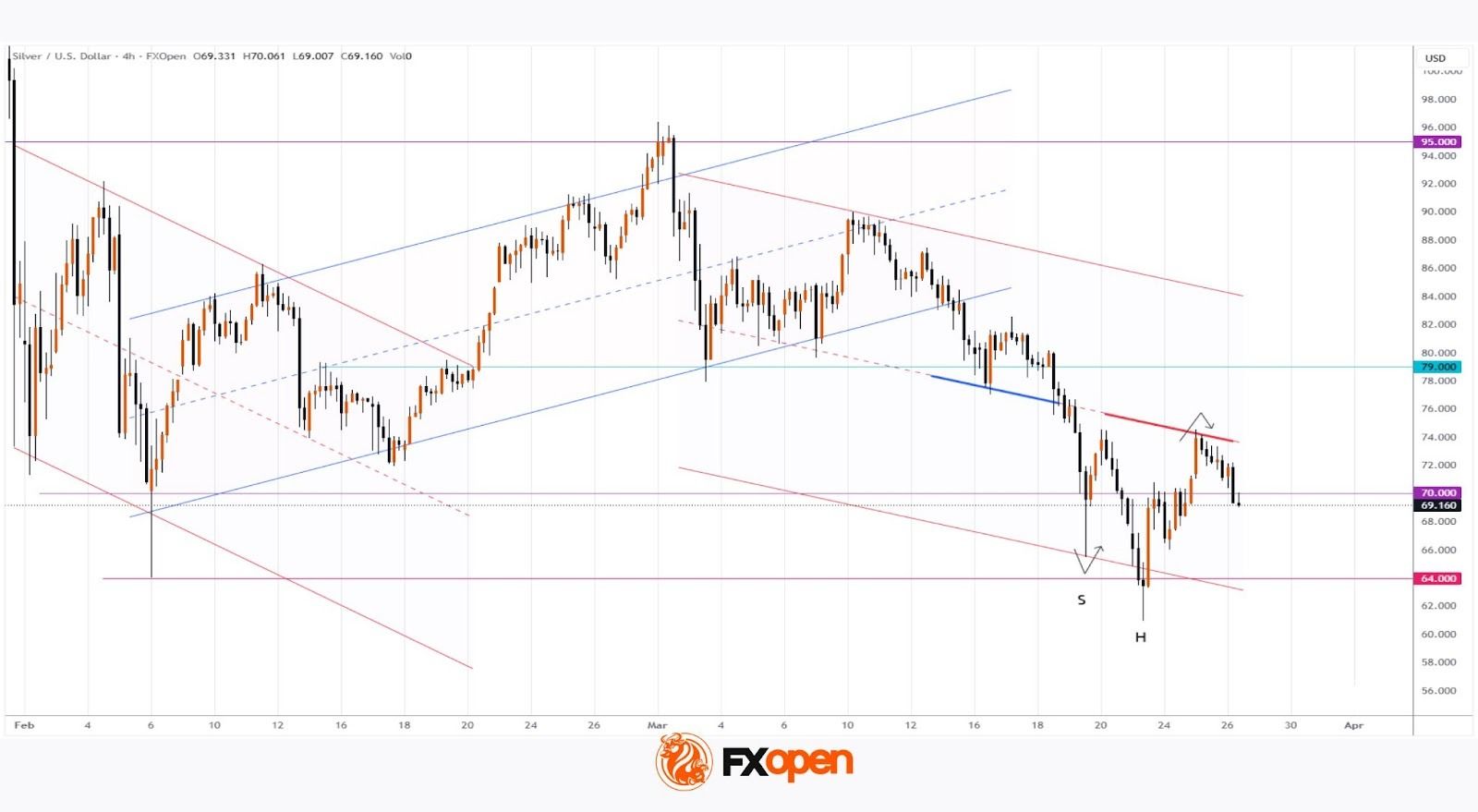
On the morning of 19 March, analysing the XAG/USD chart, we:
→ concluded that the market was under significant pressure;
→ identified and plotted a descending channel (marked in red) on the silver price chart;
→ suggested that the channel’s median line could act as near-term resistance, thereby validating the structure.
Indeed, subsequent price action confirmed this framework, as indicated by the arrows:
→ the lower boundary acted as support on the same day;
→ yesterday, price reversed lower from the median line (which shifted from support to resistance), reinforcing the prevailing bearish sentiment observed throughout March.
From a bullish perspective:
→ the break below the 6 February low around the $64 level highlights aggressive demand — so-called “smart money” may have absorbed liquidity in this zone, positioning for higher prices;
→ silver may be in the process of forming an inverse head and shoulders pattern.
However, as long as price continues to trade below the red median line of the active channel, it would be premature to speak of any meaningful bullish conviction.
Start trading commodity CFDs with tight spreads (additional fees may apply). Open your trading account now or learn more about trading commodity CFDs with FXOpen.
This article represents the opinion of the Companies operating under the FXOpen brand only. It is not to be construed as an offer, solicitation, or recommendation with respect to products and services provided by the Companies operating under the FXOpen brand, nor is it to be considered financial advice.
Stay ahead of the market!
Subscribe now to our mailing list and receive the latest market news and insights delivered directly to your inbox.


Latest articles

CAD/JPY: The Yen's Most Historic Move in 30 Years Meets a Fragile Support
Two central banks are heading in genuinely opposite directions this week, and the tension is unmistakable. The Bank of Canada held rates steady at 2.25% on September 2, with a mildly hawkish tilt as policymakers acknowledged a broadening economic

USD/JPY and USD/CAD Await Key Fed Decision
The US dollar is consolidating against the yen and Canadian dollar ahead of the key event of the week — the Federal Reserve meeting. The Fed is widely expected to raise its policy rate by 25 basis points to a range

UnitedHealth: Fundamentals Are Healing, Now the Chart Must Agree
UnitedHealth finds itself in a genuinely split narrative right now, trading near $388, down about 15.9% from its 52-week high, even as the fundamental picture keeps improving. Q2 earnings beat expectations, with revenue of $112.03 billion, and the