


USD/JPY Falls Below 150 Yen per Dollar
FXOpen

The yen was last this strong in mid-March this year. News from central banks contributed to the decline in USD/JPY.
Yesterday, the Bank of Japan raised interest rates to levels not seen in the past 15 years. Conversely, the Fed kept rates unchanged as expected but "opened the door" for a possible cut in September, according to Reuters. This news weakened the USD and provided a bullish boost to U.S. stock markets.
This shift highlights the collapse of the "carry trade" strategy, where high U.S. rates and low Japanese rates supported the rise of USD/JPY. From early 2023 to the July peak in 2024, USD/JPY rose by about 23%, but it started declining amid news of Bank of Japan's currency interventions.
On July 25, analysing the USD/JPY chart, we:
→ Constructed a descending channel (shown in red);
→ Predicted a scenario with a technical rebound from the lower boundary of the red channel.
Since then, USD/JPY climbed to the psychological mark of 155 yen per dollar on July 30, where the downtrend resumed after a false breakout.
How might the USD/JPY situation develop?
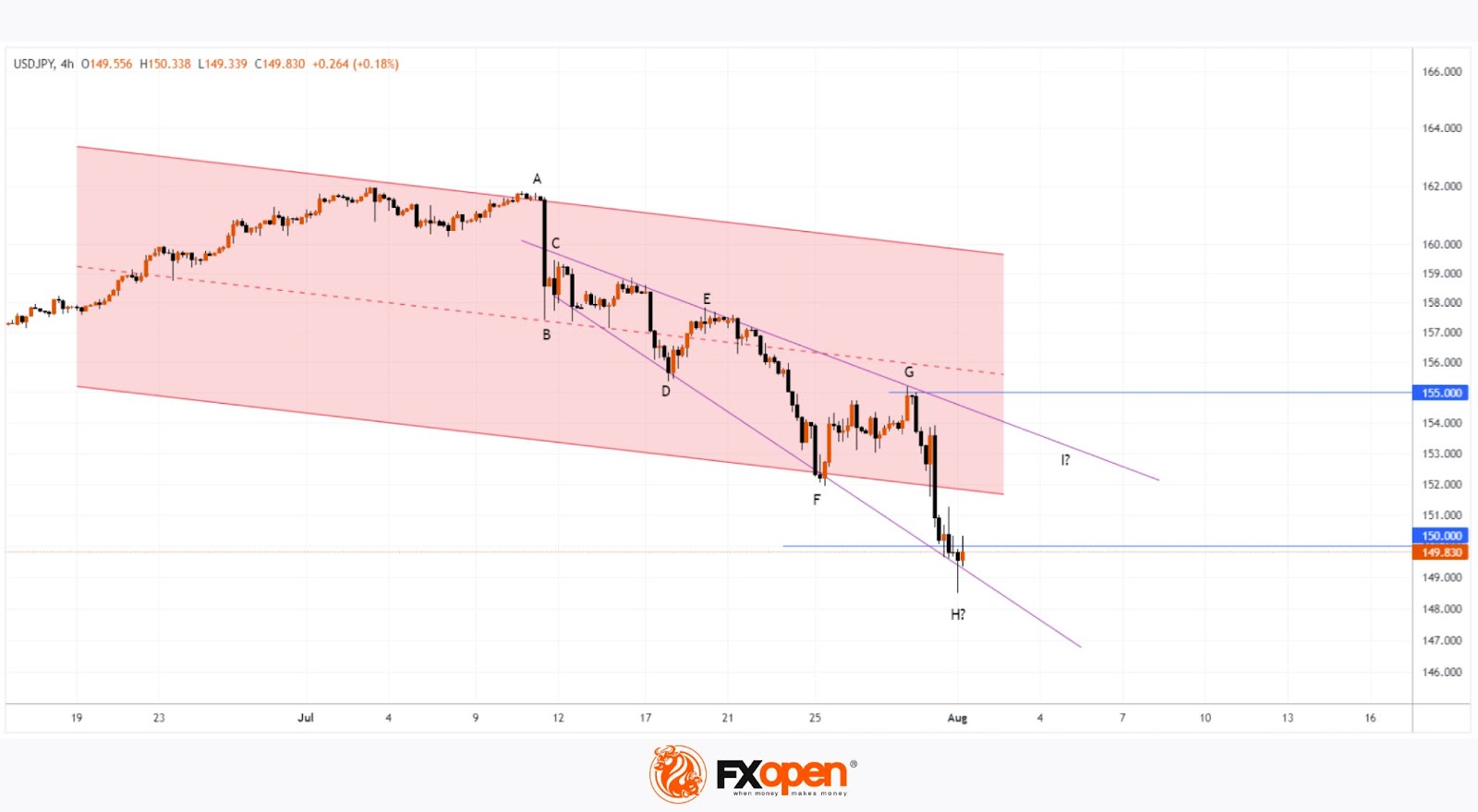
Technical Analysis of USD/JPY Today:
→ The chart forms a structure of swing extremes A-B-C-D-E-F-G. Notably, each subsequent recovery is about 50% of the previous downward impulse, indicating dominant supply forces. The expanding channel, shown in purple, also confirms this.
→ The psychological level of 150 yen per dollar may act as support, mirroring the resistance at 155 yen. Today's price action shows signs of demand activation below 150.
Therefore, it's possible that:
→ After a decline of over 8% from peak A, bears may want to take profits;
→ A corrective move H→I towards the upper purple boundary could form.
Trade over 50 forex markets 24 hours a day with FXOpen. Take advantage of low commissions, deep liquidity, and spreads from 0.0 pips (additional fees may apply). Open your FXOpen account now or learn more about trading forex with FXOpen.
This article represents the opinion of the Companies operating under the FXOpen brand only. It is not to be construed as an offer, solicitation, or recommendation with respect to products and services provided by the Companies operating under the FXOpen brand, nor is it to be considered financial advice.
Stay ahead of the market!
Subscribe now to our mailing list and receive the latest market news and insights delivered directly to your inbox.


Latest articles

CAD/JPY: The Yen's Most Historic Move in 30 Years Meets a Fragile Support
Two central banks are heading in genuinely opposite directions this week, and the tension is unmistakable. The Bank of Canada held rates steady at 2.25% on September 2, with a mildly hawkish tilt as policymakers acknowledged a broadening economic

USD/JPY and USD/CAD Await Key Fed Decision
The US dollar is consolidating against the yen and Canadian dollar ahead of the key event of the week — the Federal Reserve meeting. The Fed is widely expected to raise its policy rate by 25 basis points to a range

UnitedHealth: Fundamentals Are Healing, Now the Chart Must Agree
UnitedHealth finds itself in a genuinely split narrative right now, trading near $388, down about 15.9% from its 52-week high, even as the fundamental picture keeps improving. Q2 earnings beat expectations, with revenue of $112.03 billion, and the