


WTI Oil Price Unchanged After OPEC+ Meeting
FXOpen

The OPEC+ meeting over the weekend did not have a substantial impact on the price of crude oil. As the chart shows, WTI oil opened today at $76.72 per barrel, while on Friday it closed at $76.57 – indicating that the decision made by oil producers is ambiguous.
The bullish argument is that restrictions on oil production to maintain its price will continue. According to Reuters, on Sunday, OPEC+ members agreed to extend the production cuts of 3.66 million barrels per day until the end of 2025.
The bearish argument is that eight OPEC+ countries have already signalled plans to gradually phase out voluntary cuts of 2.2 million barrels per day from October 2024 to September 2025.
Goldman Sachs analysts overall assessed the results of the meeting as more bearish for the market. "The communication of a gradual unwind reflects a strong desire to bring back production of several members given high spare capacity," they wrote.
The WTI crude oil chart shows that the market is breaking the upward trend (shown in blue), which we mentioned in our review on 10 May.
Since then, bulls attempted to resume the upward trend, but this only resulted in a false breakout of the psychological level of $80 per barrel on 29 May (indicated by an arrow).
Afterwards, bears regained control and sharply pushed the price below the lower boundary of the blue upward channel, making the downward channel (shown in red), which began in April, more relevant.
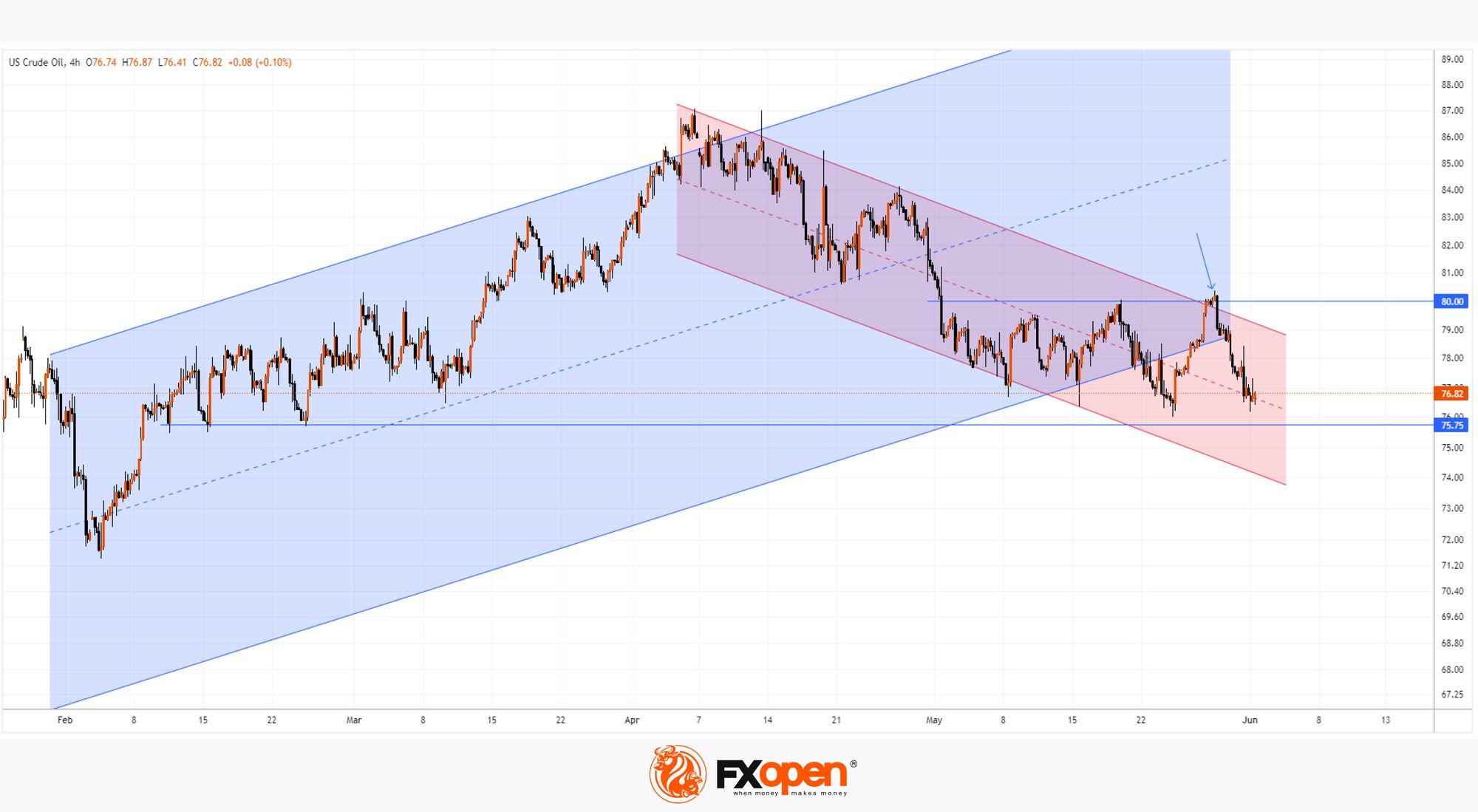
According to the technical analysis of the oil chart:
→ the price is near the median line of the red channel – a sign of temporary equilibrium between supply and demand;
→ below the current WTI crude oil price is an important level of $75.75, which provided support back at the end of winter.
If the bulls attempt a comeback (which would require fundamental drivers), the upper boundary of the downward channel may resist the price.
If the geopolitical situation in the Middle East does not escalate, the bears may continue to exert pressure aiming to break the $75.75 level – which would likely slow inflation and benefit the current U.S. administration ahead of the upcoming presidential elections.
Start trading commodity CFDs with tight spreads (additional fees may apply). Open your trading account now or learn more about trading commodity CFDs with FXOpen.
This article represents the opinion of the Companies operating under the FXOpen brand only. It is not to be construed as an offer, solicitation, or recommendation with respect to products and services provided by the Companies operating under the FXOpen brand, nor is it to be considered financial advice.
Stay ahead of the market!
Subscribe now to our mailing list and receive the latest market news and insights delivered directly to your inbox.


Latest articles

CAD/JPY: The Yen's Most Historic Move in 30 Years Meets a Fragile Support
Two central banks are heading in genuinely opposite directions this week, and the tension is unmistakable. The Bank of Canada held rates steady at 2.25% on September 2, with a mildly hawkish tilt as policymakers acknowledged a broadening economic

USD/JPY and USD/CAD Await Key Fed Decision
The US dollar is consolidating against the yen and Canadian dollar ahead of the key event of the week — the Federal Reserve meeting. The Fed is widely expected to raise its policy rate by 25 basis points to a range

UnitedHealth: Fundamentals Are Healing, Now the Chart Must Agree
UnitedHealth finds itself in a genuinely split narrative right now, trading near $388, down about 15.9% from its 52-week high, even as the fundamental picture keeps improving. Q2 earnings beat expectations, with revenue of $112.03 billion, and the