


FXOpen
Yesterday, NVDA’s stock price fell to 116.61 – its lowest level since June 5th.
The bearish sentiment was triggered by Trump’s cautious remarks regarding the necessity to defend Taiwan from the threat of military action by China. The leading pre-election candidate suggested in a Bloomberg interview that the island should pay for US defensive support, leading to a drop in semiconductor manufacturers' stock prices: TSMC fell by 8%, and Nvidia shares dropped by 6.6% during yesterday's session, as its primary AI chip producer is Taiwan Semiconductor Manufacturing.
However, today in pre-market trading, NVDA's price is recovering, rising above $120 per share. How might the situation develop further?
Let us recall that on 10th July, we wrote about strong seller pressure above the $130 per share level. Since then, the price has declined by approximately 9%.
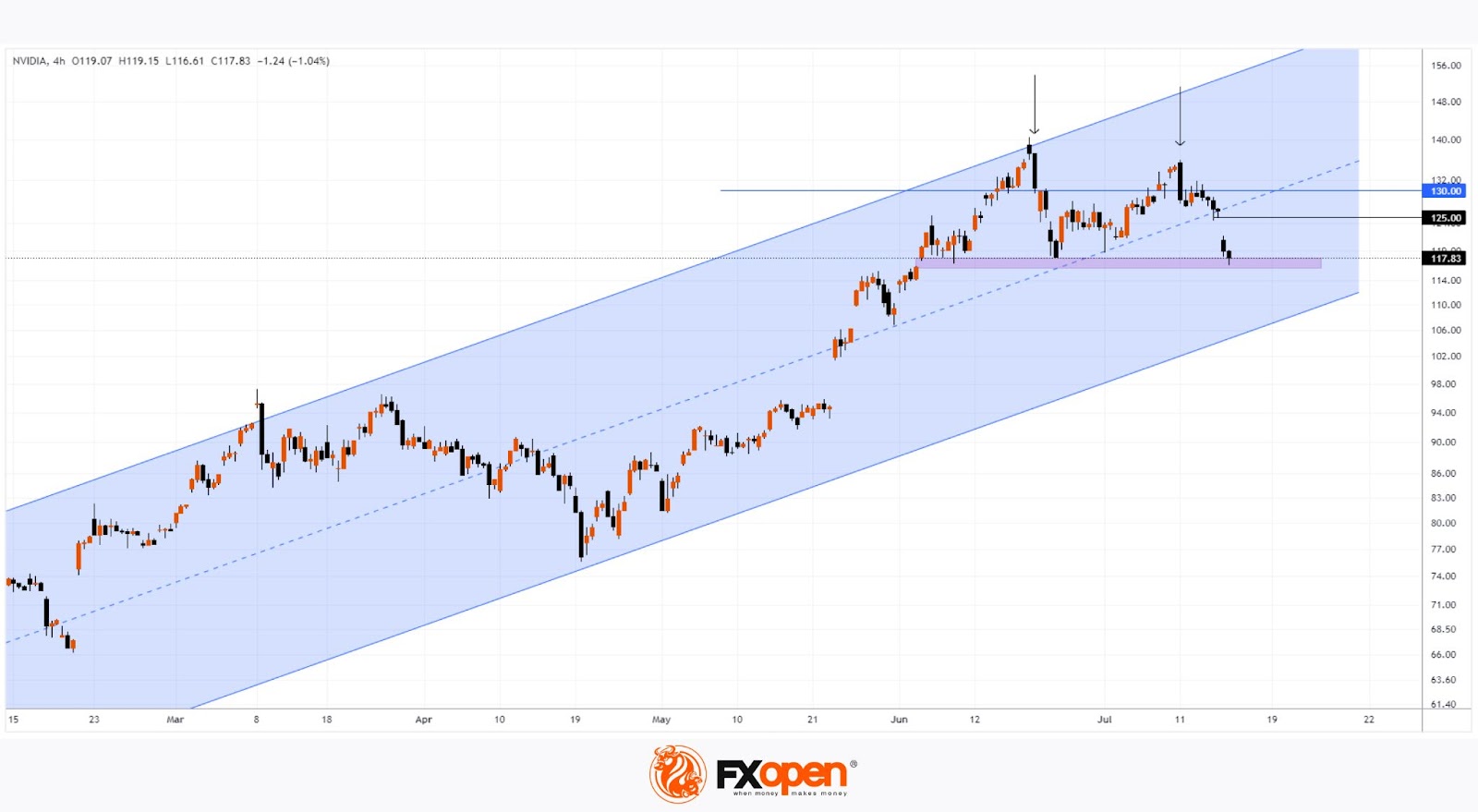
Technical analysis of NVDA’s chart today shows that:
→ Bears have twice (indicated by arrows) aggressively pushed the price down when it was above the mentioned level;
→ The price found support from the gap zone around the $115 level, where bulls broke through the May highs on June 4-5;
→ The price is still moving within the upward channel (shown in blue), but has dropped into the lower half;
→ Additionally, the price has formed a wide bearish gap with the upper boundary at $125.
Investor concerns should not only focus on Trump’s remarks but also on the fact that NVDA's price is underperforming the stock index, despite being a market leader in the first half of the year. If bears continue to hold the initiative, we may see signs of their aggression not from the $130 level, but from the $125 level – if this happens, the lower boundary of the current blue channel will be at risk of a breakout.
Buy and sell stocks of the world's biggest publicly-listed companies with CFDs on FXOpen’s trading platform. Open your FXOpen account now or learn more about trading share CFDs with FXOpen.
This article represents the opinion of the Companies operating under the FXOpen brand only. It is not to be construed as an offer, solicitation, or recommendation with respect to products and services provided by the Companies operating under the FXOpen brand, nor is it to be considered financial advice.
Stay ahead of the market!
Subscribe now to our mailing list and receive the latest market news and insights delivered directly to your inbox.


Latest articles

FX Markets Are Changing: What’s Driving Currencies Now?
FX markets have become increasingly reactive in March, with geopolitical developments—particularly the US–Iran conflict—driving price action across currencies, commodities, and interest rate expectations.
In this update, we examine the key forces shaping the FX market right now,

GBP/USD Rises Following Bank of England Decision
Yesterday, the Bank of England’s decision had a significant impact on the pound, which strengthened against other currencies. Although the Official Bank Rate remained unchanged at 3.75%, the market was surprised by the “hawkish” signals, which sharply contrasted
S&P 500 Analysis: Index Falls to Year-to-Date Low
As the S&P 500 chart (US SPX 500 mini on FXOpen) shows, the index dropped below the 6,570 level yesterday for the first time in 2026. As a result, the equity market may be on track to